Major Arcana · XV
The Devil can be read as a prompt to examine attachment, pressure and restricted choice. It is not evidence of a curse, possession or an evil person. Its value lies in asking what limits your freedom and what realistic support could help—not in creating fear.
Upright
Attachment, pressure, a costly pattern or restricted choice.
Reversed
Questioning a constraint, seeking support or beginning to loosen a pattern.
A question to explore
What limits my choices, and which part can I address safely?
Imagery and symbolism
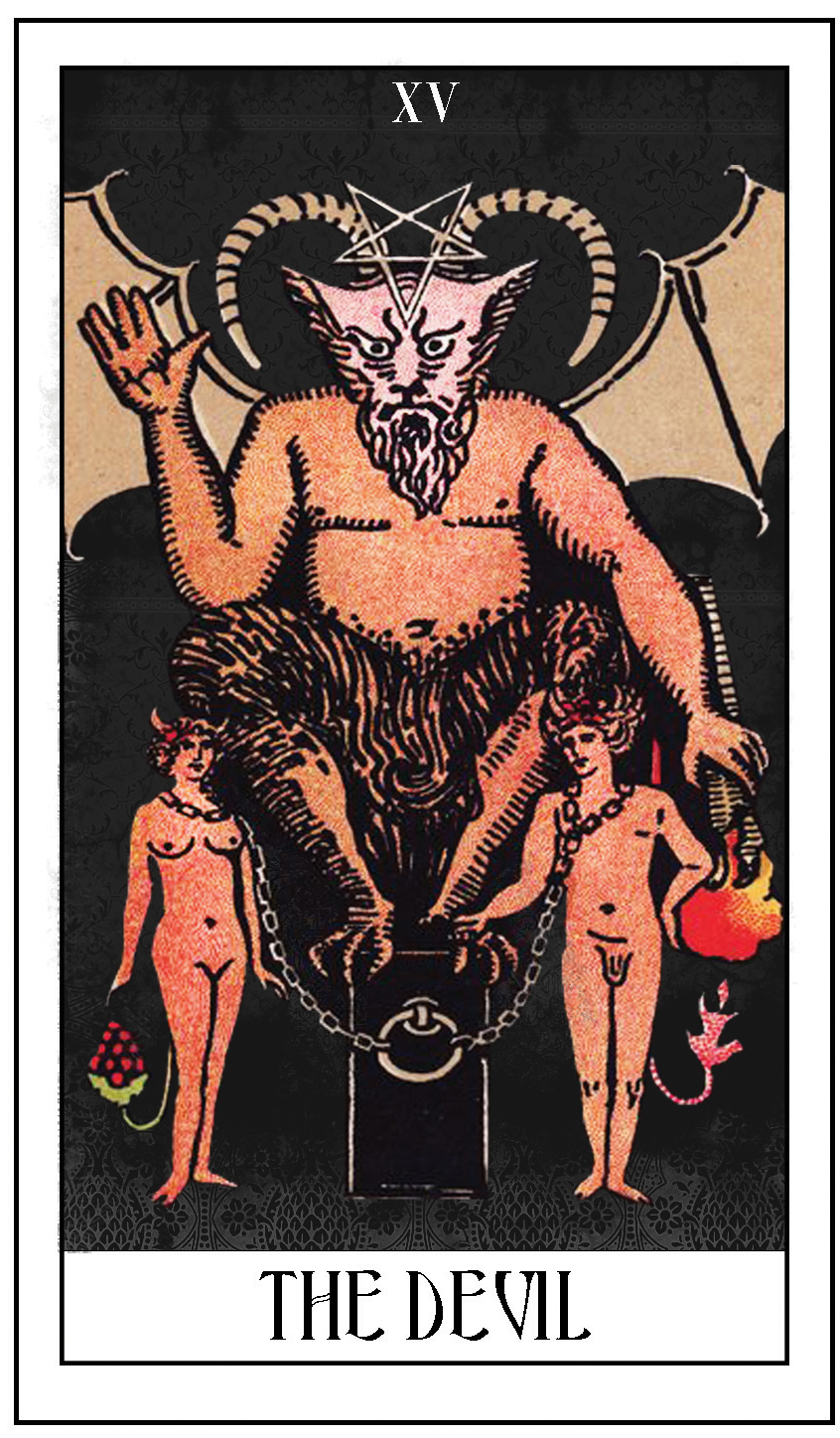
In the Rider–Waite–Smith image, a horned, winged figure stands above two chained human figures and holds a downward-pointing torch. The imagery draws on religious symbolism. A contemporary reading may explore constraint and attachment without adopting the image as a literal claim about supernatural forces.
Devil upright
Upright, identify a specific pattern and its cost. It might involve an obligation, spending habit or pressure to keep returning for reassurance. Avoid blaming yourself: constraints can be economic, social or interpersonal, and change may require help.
Devil reversed
Reversed, consider whether you are recognizing an unhelpful pattern or testing a different response. A card cannot certify that a problem is solved. Look for practical changes, reliable support and a plan that fits your circumstances.
Love and relationships
Consider consent, freedom to disagree and the ability to maintain outside support. Do not label someone abusive or unfaithful from a card, but take actual controlling or threatening behavior seriously.
Work and study
Read obligations and working conditions carefully. A difficult job may involve real financial constraints; plan alternatives without assuming you can simply walk away.
Money and practical decisions
Check recurring charges, borrowing terms and pressure-based offers. Never pay a reader to remove a curse or avert a disaster supposedly revealed by this card.
Past, present and future positions
Past
Identify a pattern you previously mistook for an unavoidable rule.
Present
Separate an actual constraint from an assumption about what you must do.
Future
Choose a realistic step toward more choice, with support where needed.
Well-being and personal growth
Tarot cannot diagnose an addiction or mental-health condition. If a pattern is causing harm, seek qualified support rather than relying on a reading to establish or resolve it.
How it differs from nearby cards
The Lovers explores freely chosen connection and values; the Devil can highlight restrictions on choice. Strength offers a contrast in patient, non-coercive courage.
Try this reflection exercise
- Name one pressure without judging yourself.
- List what is within your control and what requires outside help.
- Choose a safe next step and a person or service that can support it.
Frequently asked questions
Is the Devil a yes or no card?
Readers assign different yes-or-no conventions. A more useful approach is to explore the card’s theme and then check the real conditions of your decision. What limits my choices, and which part can I address safely?
Does the Devil mean I am cursed?
No. A card is not evidence of a curse or possession. Treat demands for money to remove a curse or prevent harm as a serious warning sign.
Do reversed cards always have a negative meaning?
No. A reversal may be read as a delay, an internal experience or a theme that needs adjustment. Decide how you use reversals before the reading and consider the question and surrounding cards.
Historical reference: A. E. Waite, The Pictorial Key to the Tarot. The practical questions here are contemporary interpretations of the imagery, not factual predictions.
The interpretation of the Devil card in various aspects of life is quite comprehensive. The emphasis on self-control and personal growth resonates deeply for many scenarios described.
The exploration of the Devil card in this piece is thorough. I appreciate the delineation of its significance across different life areas like work, love, and health. It provides a balanced perspective.
This article offers a nuanced perspective on the Devil card, moving beyond its typical negative connotations. It’s helpful to see how it can represent both challenges and opportunities for personal growth.
The analysis provided is detailed and informative. The Devil card’s association with themes such as addiction and self-improvement is particularly thought-provoking, offering much for the reader to consider.
The article provides an insightful analysis of the Devil card, delineating its implications in past, present, and future contexts. The correlation with Capricorn and earth adds an interesting astrological dimension.