Major Arcana · V
The Hierophant explores inherited teaching, institutions and shared practice. It can prompt you to learn from a tradition while also examining how it fits your values. The card does not require a religion, unquestioning obedience or a particular level of spirituality.
Upright
Tradition, shared learning, mentorship and established practice.
Reversed
Questioning convention, an unsuitable authority or choosing a different approach.
A question to explore
Which teaching is useful to me, and what am I free to question?
Imagery and symbolism
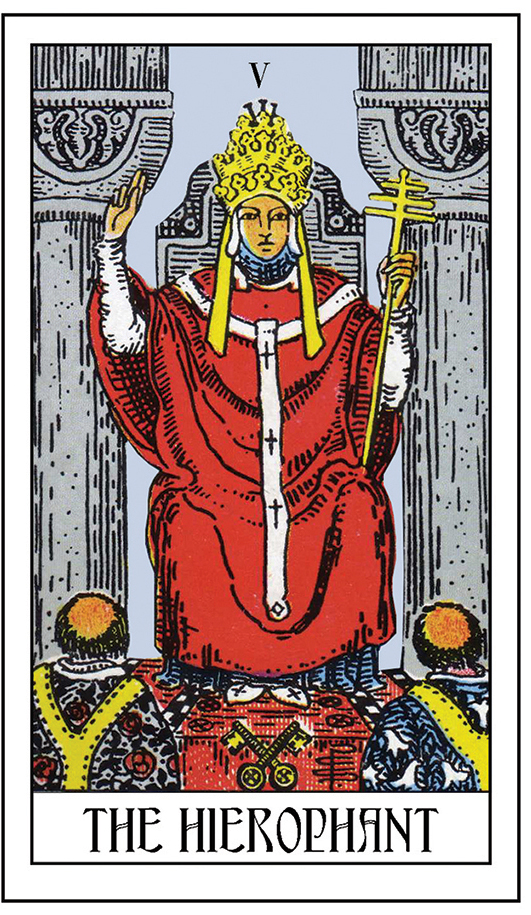
The Rider–Waite–Smith image shows a religious figure between pillars, with crossed keys and two attendants below. Its visible ecclesiastical symbols matter: this is not a culturally neutral image. Contemporary readings may extend the theme toward education, mentorship or institutional customs.
Hierophant upright
Upright, consider what a tested method or knowledgeable teacher can offer. Ask about the context, purpose and limits of the teaching. Participation should leave room for informed choice, questions and respectful disagreement.
Hierophant reversed
Reversed, you may be reassessing a convention or finding that an institution does not meet your needs. Disagreement is not proof that you lack spirituality. Explore alternatives with the same care you would apply to an established path.
Love and relationships
Discuss values, expectations and the meaning of commitment. The card can evoke formal partnership, but it does not predict marriage or require a traditional relationship structure.
Work and study
Learn the relevant procedures and qualifications, then ask why they exist. A mentor can help when their expertise fits the question and their boundaries are appropriate.
Money and practical decisions
Read formal agreements and use qualified guidance for complex matters. No option becomes risk-free because it is traditional or endorsed by an authority.
Past, present and future positions
Past
Consider a community or teaching that influenced your values.
Present
Ask what you want to learn and whether the source is suitable.
Future
Explore what participation would require before making a commitment.
Learn from tradition and find your place within it
The Hierophant brings attention to teaching, shared practice and the wisdom carried through a community. You may be invited to learn a tradition more patiently, ask a mentor a thoughtful question or consider which practices express your values. Belonging can include respectful inquiry.
How it differs from nearby cards
The High Priestess emphasizes private observation and concealed knowledge; the Hierophant emphasizes shared or institutional teaching. The Hermit offers another image of inquiry.
Try this reflection exercise
- Name one teaching or convention you follow.
- Write what it offers and what you question.
- Choose a source or conversation that allows thoughtful inquiry.
Hierophant in a reading: an example
Suppose you are studying a tarot system whose correspondences feel unfamiliar. In a position about learning, the Hierophant could suggest working with one teacher or guidebook long enough to understand its structure before blending several systems. The Page of Pentacles adds the student’s curiosity; the High Priestess leaves room for personal reflection. Study and intuition can enrich each other when you know which part of the interpretation comes from each.
Try it in your own reading
Choose one practice, learn its context and write what it means to you. Understanding a tradition gives you a clearer basis for adopting or adapting it.
Frequently asked questions
Does the Hierophant mean I must become more religious?
No. It may invite reflection on traditions and institutions, but your beliefs and participation remain your choice.
Explore Hierophant in A. E. Waite, The Pictorial Key to the Tarot.
This article presents a clear and structured insight into the Hierophant card, making it accessible even to those new to tarot. The explanations for past, present, and future positions are particularly useful for contextualizing the card’s significance in a reading.
The Hierophant’s association with stability and tradition, as outlined, is a reassuring aspect for those looking for guidance. The practical advice regarding work, love, and health underscores the card’s relevance to real-life scenarios.
The symbolism of the Hierophant card as described aligns well with traditional interpretations. It emphasizes the balance between spiritual growth and practical life decisions. This is crucial for anyone seeking guidance through tarot readings.
The analysis provided on the Hierophant card is comprehensive. I appreciate the detailed breakdown of the card’s implications across different aspects of life, such as work, love, and finances. It provides a holistic view of what one can expect and how to navigate various situations.
The mention of the Hierophant card in reverse is a valuable addition. It highlights the importance of introspection and understanding one’s own spiritual journey, which can often be overlooked in standard readings. This adds depth to the card’s interpretation.