

Pentacles · Earth · Minor Arcana
The Two of Pentacles explores the daily work of balancing responsibilities. It can describe flexibility and resourcefulness, alongside the effort required to keep several demands moving.
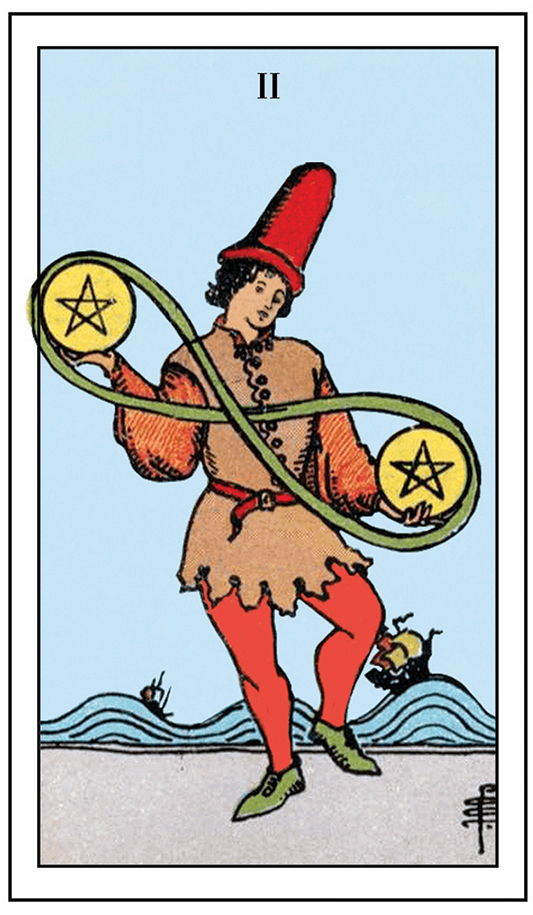
Upright
Adaptability, scheduling, competing demands.
Reversed
Overcommitment, uneven attention or a dropped responsibility.
A question to explore
Which commitment needs more room, and which can change?
Imagery and symbolism
A figure handles two pentacles linked by a looping ribbon while ships move on waves behind. The scene can be read as adapting to movement rather than achieving perfect stillness.
Two of Pentacles upright
Upright, look for a rhythm that fits the actual workload. Balance may require changing the plan from week to week. Put deadlines, rest and essential tasks in the same view before adding another commitment.
Two of Pentacles reversed
Reversed, juggling may have become unsustainable. Identify what is urgent, what matters over time and what can be renegotiated. The aim is a workable arrangement rather than proving you can carry everything.
Love and relationships
Talk about availability instead of treating a busy schedule as proof of someone’s feelings. Agree on time together and communicate changes early.
Work and study
Check whether deadlines compete for the same hours. Break work into smaller stages and make tradeoffs explicit before promising delivery.
Money and practical decisions
Use a cash-flow calendar to see when bills and income fall. Cards do not establish whether a payment will arrive on time.
Find a rhythm that leaves room to breathe
Balance in the Two of Pentacles is a moving rhythm, not a perfectly still pose. The card can encourage flexibility and remind you that adjusting your pace is part of caring for what matters. You can honor two commitments without giving each the same amount of time every day.
How it differs from nearby cards
The Two concerns adjustment; the Four asks what you hold securely, and the Three asks how people coordinate.
Try this reflection exercise
- Which commitment needs more room, and which can change?
- Write one observation that supports your interpretation and one that challenges it.
- Choose a small action you can review after trying it, without drawing again for permission.
Two of Pentacles in a reading: an example
Suppose you are combining an evening course with a weekend market stall. In a reading about your weekly routine, the Two of Pentacles might invite a rotating schedule: study earlier when the market is busy, then give the course more attention during a quieter week. With Temperance, look for a sustainable blend; with the Ten of Wands, examine whether the arrangement has grown too heavy. The useful question is which change would make the rhythm easier, rather than which commitment you must immediately abandon.
Try it in your own reading
Try drawing your week as a wave. Mark the busiest points and place one helpful buffer before each peak.
Frequently asked questions
Does this card mean I must choose between two people?
No. Two objects can symbolize competing priorities, but they do not identify a love triangle. Read the image in relation to your stated question.
Explore Two of Pentacles in A. E. Waite, The Pictorial Key to the Tarot.
The interpretation of the Two of Pentacles as a symbol of balance and change is quite intriguing. It suggests a nuanced understanding of balance, not just as equilibrium but also as an ongoing process of adaptation.
The element of earth associated with the Two of Pentacles underscores its grounding nature. This card seems to serve as a reminder that practical, tangible balance is essential in navigating life’s complexities.
I find the notion that neither choice is inherently good or bad, just different, to be quite thought-provoking. It encourages a more open-minded approach to decision-making.
The insights on how the Two of Pentacles is relevant to various aspects of life, such as work, love, and health, are comprehensive. It’s clear that balance and adaptability are key themes.
The card’s emphasis on balancing work and personal life resonates with many modern challenges. The advice on setting priorities and focusing on fewer tasks aligns well with contemporary productivity methodologies.