Card library · Air
Swords explores thought, language, decisions and conflict. Its sharp imagery can be unsettling, but the suit is not a catalogue of disasters. It can help you separate observation from assumption, make room for rest and choose how to communicate.
How to read Swords
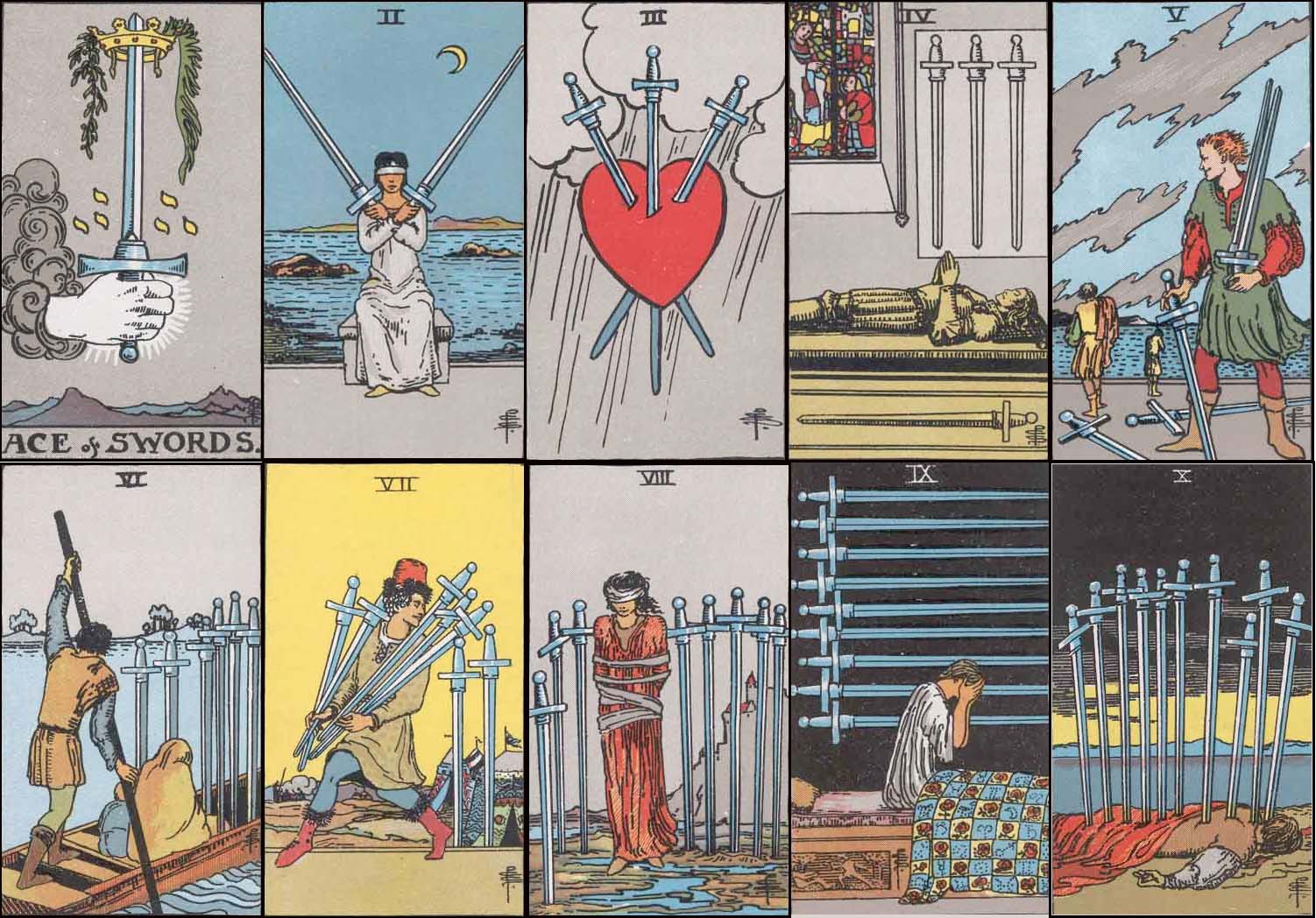
Swords scenes range from a raised blade to a resting figure and a boat crossing water. Reading the actual image matters more than labeling the whole suit negative. The common Air association offers a language for ideas and communication; it does not make a card evidence of someone’s private thoughts.
A question to begin with
What do I know, what am I assuming, and what needs to be said?
Explore all 14 cards
Ace of Swords
Clarity, a new idea, truthful communication and a decisive question.
Two of Swords
A pause, competing priorities, a truce and a difficult choice.
Three of Swords
Sorrow, disappointment, separation and an uncomfortable truth.
Four of Swords
Rest, a considered pause, reflection and protected time.
Five of Swords
Conflict, a hollow victory, damaged trust and the cost of winning.
Six of Swords
Transition, assistance, distance and a gradual change of perspective.
Seven of Swords
Strategy, discretion, evasion and accountability.
Eight of Swords
Restriction, uncertainty, limited options and a need for support.
Nine of Swords
Worry, regret, distress and thoughts that feel difficult to set aside.
Ten of Swords
An ending, exhaustion of an approach, finality and acknowledging a limit.
Page of Swords
Curiosity, alertness and clear communication.
Knight of Swords
Decisive action, advocacy, urgency and focused effort.
Queen of Swords
Discernment, independence, clear speech and considered boundaries.
King of Swords
Reasoned judgment, expertise, standards and accountable authority.
Reading the court cards
The Page can represent curiosity; the Knight, rapid action or speech; the Queen, discernment and boundaries; and the King, clear standards. Any person can explore these qualities. Court cards cannot identify a stranger’s character or intentions.
Put the theme into context
The Two of Swords can prompt you to identify missing information before a decision. The Seven may raise questions about strategy or privacy, but it cannot prove deception. The Nine can give language to worry without diagnosing a condition.
Upright and reversed meanings
With a reversed Page of Swords, consider whether curiosity has become scattered or a message needs more context. A reversed Queen of Swords may invite gentler wording without losing clarity. These readings differ because the court cards express different relationships with thought and communication.
Are Swords cards always bad?
No. They include clarity, learning, recovery and transition as well as difficult themes. Even a dramatic image does not predict harm; interpret it in context and use real-world evidence.
Explore traditional Swords imagery in A. E. Waite’s The Pictorial Key to the Tarot.
Notice the different uses of a sharp mind
Swords explore more than conflict. The Ace can offer clarity, the Page curiosity, the Queen discerning speech and the King an understandable decision process. The harder images give uncertainty, grief and pressure a place in the reading. Seeing the range helps you approach the suit with interest rather than assume that every Sword is bad news.
Follow a thought from question to conversation
Compare the Page, Knight and Queen of Swords. The Page asks; the Knight moves quickly; the Queen chooses words with experience. Imagine a message you want to send and consider what each quality contributes. You may need curiosity before speed, or a clear boundary before further discussion. The court cards become useful voices rather than fixed labels for people.
The Suit of Swords seems to emphasize rational thought and intellect over emotional responses. This is a useful reminder of the importance of balanced decision-making.
It’s fascinating how the Suit of Swords is predominantly linked with intellect, conflicts, and decision-making. The distinctions between each card clarify how nuanced tarot readings can be.
The descriptions of each card provide useful insights for beginners and seasoned tarot readers alike. It’s crucial to remember the context of the entire reading when interpreting each card.
The way each card is broken down makes it easier to understand their implications. It’s particularly interesting that many cards in this suit have dual meanings.
Indeed, the duality in the cards means that their interpretation can vary significantly based on the surrounding cards and the context of the query.
The detailed explanation of each card in the Suit of Swords provides a comprehensive overview for those interested in tarot. It’s intriguing to see how each card holds both positive and negative connotations depending on their context.