
Major Arcana · XIV
Temperance offers an image of measured adjustment: bringing different needs together without expecting instant harmony. It can prompt patience, proportion and experimentation. Balance does not always mean equal amounts, and it never requires compromising your safety.
Upright
Integration, proportion, patience and a workable rhythm.
Reversed
Imbalance, incompatible demands or an adjustment that needs attention.
A question to explore
What small adjustment would make this situation more workable?
Imagery and symbolism
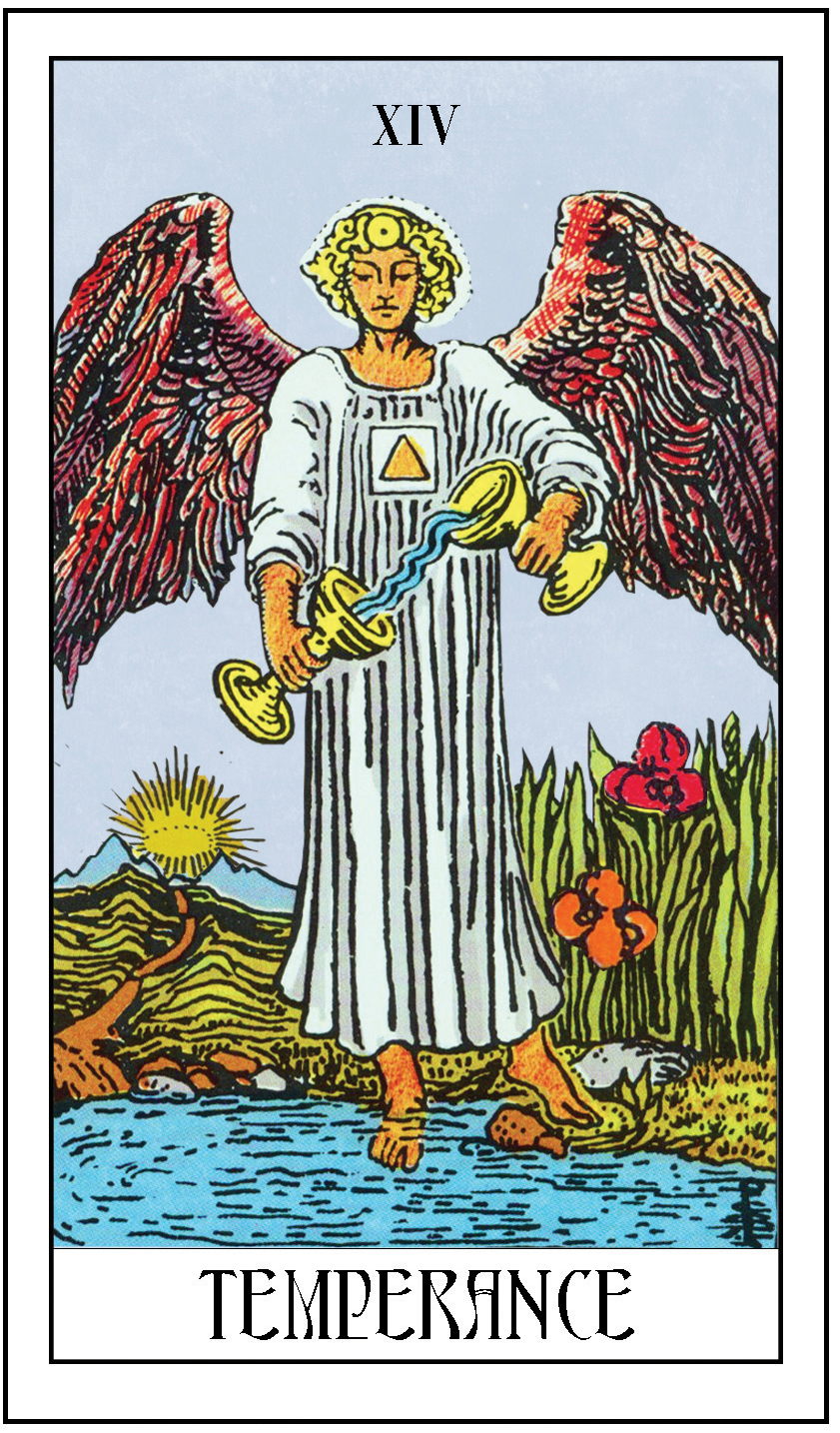
In the Rider–Waite–Smith scene, a winged figure pours liquid between two cups, with one foot on land and one in water. A path leads toward distant light. Waite describes combination and harmonizing; the movement between cups provides a practical metaphor for adjusting a mixture rather than choosing an extreme.
Temperance upright
Upright, consider how different parts can work together. A realistic routine leaves room for limits, feedback and changing circumstances. Rather than declaring a perfect balance, try a modest adjustment and observe whether it helps.
Temperance reversed
Reversed, locate the actual imbalance: time, responsibility, expectations or resources. An overloaded schedule may need fewer commitments, not a more ambitious routine. You can change one part without judging your whole life as out of control.
Love and relationships
Discuss a pace and division of effort that both people freely accept. Compromise is useful only when needs and boundaries are respected; it is not a solution to coercion.
Work and study
Coordinate competing priorities and clarify what can reasonably fit. A trial process with a review date can reveal more than a promise to manage everything.
Money and practical decisions
Compare regular commitments with available resources. A steady plan should use real figures, not an assumption that moderation alone guarantees security.
Past, present and future positions
Past
Notice an adjustment that made cooperation easier.
Present
Identify a demand that needs a different proportion of your time or attention.
Future
Try a sustainable rhythm and decide how you will evaluate it.
Find the blend that brings the parts into harmony
Temperance can invite a patient, intuitive adjustment between different needs. Its spiritual beauty lies in the art of combining: enough structure with enough freedom, enough effort with enough rest. Balance develops through attention to how the parts feel together.
How it differs from nearby cards
The Two of Pentacles focuses on juggling everyday demands. Temperance emphasizes integration, while the Chariot emphasizes a chosen direction.
Try this reflection exercise
- Name two needs that seem to compete.
- Describe a small arrangement that gives each appropriate attention.
- Set a review point and one observable sign that the arrangement is helping.
Temperance in a reading: an example
Imagine you are blending two creative styles in a handmade gift. Temperance in a position about approach might suggest testing a small sample before deciding on the final mixture. The Magician supplies the materials; the Two of Pentacles helps vary the rhythm of the work. A satisfying blend may emerge through several small adjustments rather than one perfect formula.
Try it in your own reading
Change one element at a time and notice the effect. Ask what would bring the experience closer to the quality you want: ease, warmth, clarity or liveliness.
Frequently asked questions
Does Temperance mean I should always compromise?
No. Some differences can be negotiated; consent, dignity and safety are not bargaining chips. The card can invite thoughtful adjustment without requiring you to accept harm.
Explore Temperance in A. E. Waite, The Pictorial Key to the Tarot.
The article provides a comprehensive overview of the Temperance card. It’s interesting to note the emphasis on balance and moderation across various aspects of life. The insights into how the card manifests in past, present, and future positions are quite enriching.
It’s intriguing how the Temperance card is linked to self-control and abstinence. The notion that this card can signify a shift towards better health and wellbeing in the future is particularly reassuring.
The reverse position of the Temperance card provides an interesting counterpoint, emphasizing the need to address imbalances and addictions. This balanced view of both positive and negative aspects makes the interpretation quite holistic.
The association of Temperance with the fire element and Sagittarius adds a layer of depth that is often overlooked. This perspective helps in understanding the broader implications of the card in a more astrological context.
I appreciate the detailed explanation of how the Temperance card interacts with different areas such as work, love, and health. The idea that balance is a key theme running through the interpretation offers valuable guidance for personal reflection.