Psychic.Cards · A considered reading
The Moon can make a love reading feel emotionally rich: longing, intuition and uncertainty may all be present.
Give an uncertain feeling a careful question
Rather than label the relationship from one image, ask which part of your experience feels unclear. Are you waiting for a conversation, unsure about your own wishes or responding to a change in routine? Naming the particular uncertainty gives the reading a gentler and more useful direction.
Try pairing the Moon with a question about what you can communicate. With the Queen of Cups, you might explore how to express a feeling warmly; with the Ace of Swords, how to ask something plainly. An intuitive impression can help you notice a concern, but the other person’s intentions are theirs to explain. Leave space for an answer you have not imagined.
Notice the unclear path
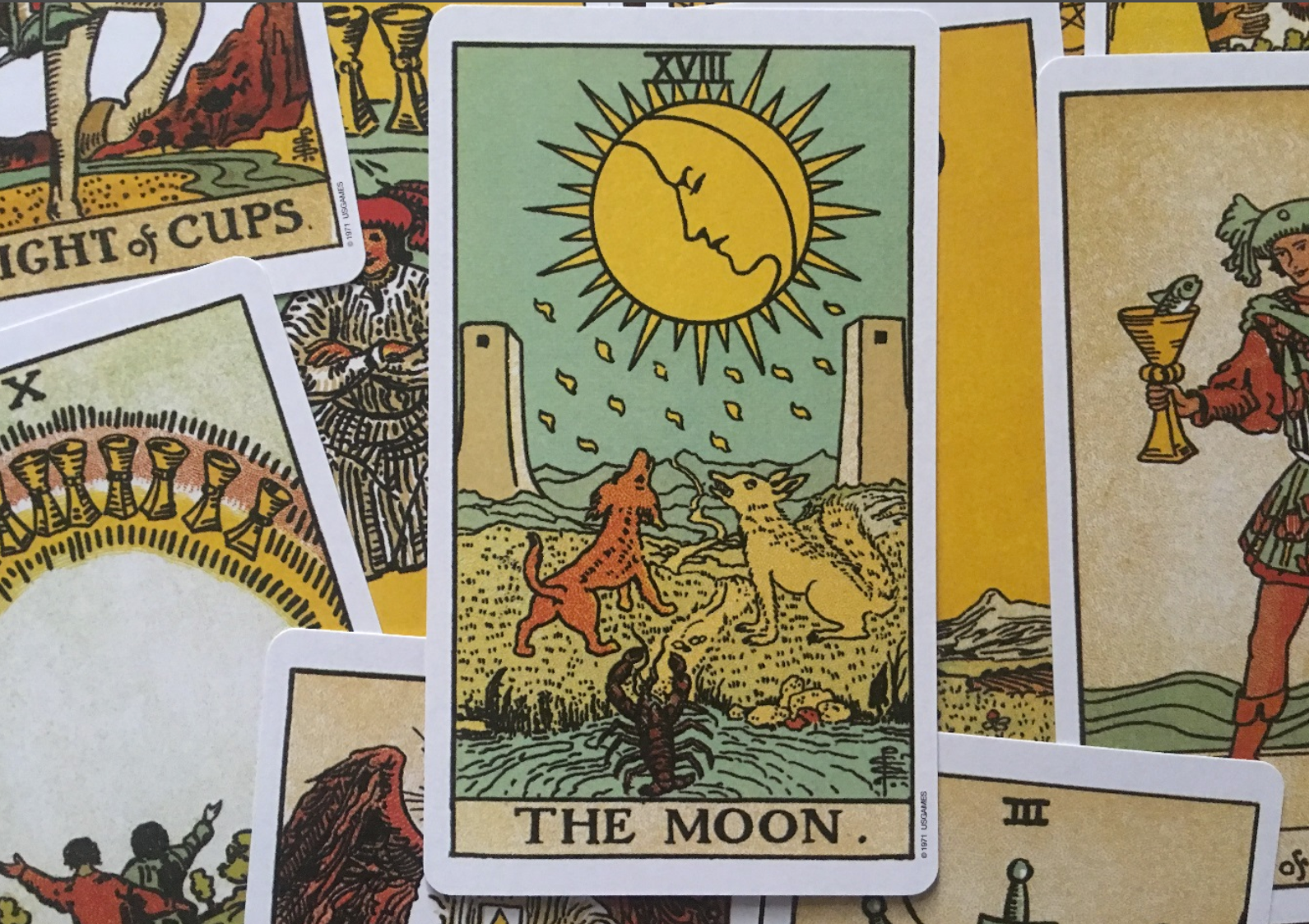
In the Rider–Waite–Smith scene, a path runs between towers under the moon. The imagery can suggest moving through conditions you do not fully understand. In a relationship reading, ask what is genuinely unknown rather than filling the gap with the most frightening story.
Separate feeling, fact and assumption
“I feel uneasy,” “we have not discussed exclusivity,” and “they must be unfaithful” are different statements. The first is a feeling, the second may be an observable fact, and the third needs evidence. A card cannot bridge that gap.
Choose a respectful next step
You might ask a direct question, state a boundary or take time to consider what you need. Do not monitor someone’s accounts or override a refusal because a reading suggests a hidden bond. A reversed Moon can invite clarification, but it does not guarantee that the truth has been revealed.
Put it into practice
- Write one feeling, one fact and one assumption.
- Ask what information could clarify the situation.
- Choose a conversation or boundary that does not require mind-reading.
Image tradition: Waite’s Moon description.
The interpretation of the Moon card as both inspirational and challenging is quite intriguing. It seems to encapsulate the duality of human experience, where one’s internal struggles can either hinder or propel personal growth.
The dual nature of the Moon card, embodying both deception and intuition, offers a nuanced perspective on personal growth. It’s a reminder that understanding oneself requires acknowledging both strengths and weaknesses.
Incorporating hypnotherapy with tarot readings to uncover emotional blockages is an interesting approach. The idea of using the Moon card to navigate through illusions and fears resonates with the complexities of human psychology.
The concept of creating a vision board and using meditation to manifest desires is quite practical. It adds a structured method to what might otherwise seem like abstract spiritual guidance from the Moon card.
The article’s emphasis on working through challenges before attracting positive outcomes aligns well with many psychological theories on resilience and self-improvement. It’s a balanced view that encourages both introspection and proactive effort.