Swords · Air · Minor Arcana
The Ten of Swords is a stark image of an ending, defeat or reaching a limit. Its intensity can feel unsettling, but it is not a literal prediction of injury, death or disaster. Read it as a question about what is exhausted and what support is needed next.
Upright
An ending, exhaustion of an approach, finality and acknowledging a limit.
Reversed
Recovery being considered, difficulty accepting an ending or a need for support.
A question to explore
What can no longer continue in its current form?
Imagery and symbolism
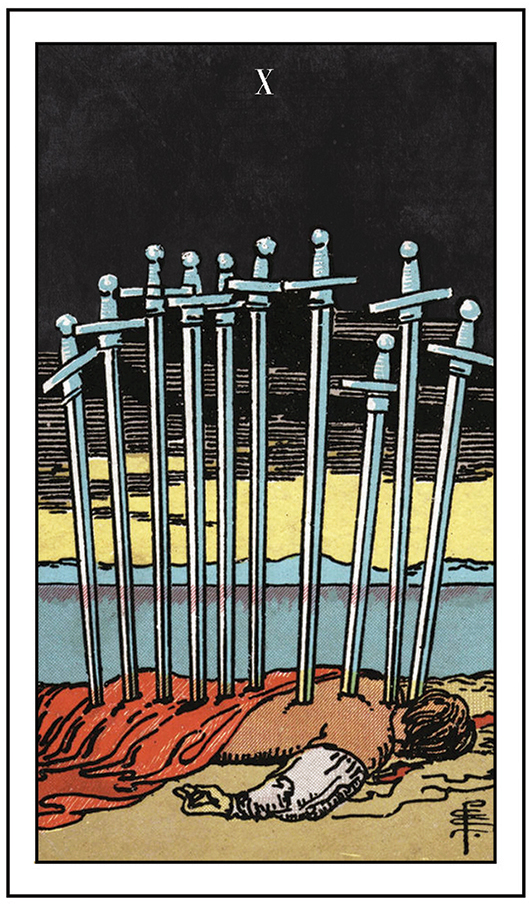
In the Rider–Waite–Smith scene, a prone figure lies beneath ten swords while light appears along the horizon. The deliberately extreme image can symbolize finality or the feeling that something cannot continue as before. The changing sky allows a different perspective without promising an easy recovery.
Ten of Swords upright
Upright, name the particular process or expectation that has reached its limit. Avoid expanding a setback into a verdict on your whole life. There may still be practical matters to settle, people to contact and choices about how to respond.
Ten of Swords reversed
Reversed, consider whether you are beginning to rebuild or holding on to something already finished. Neither interpretation gives a deadline. Take realistic stock of support and obligations rather than demanding immediate optimism from yourself.
Love and relationships
The card does not prove that a relationship is over or that betrayal occurred. If an ending has happened, allow for grief and practical boundaries. If it has not, use the image to discuss an unsustainable pattern rather than pronounce a breakup.
Work and study
Review a failed project or an unworkable workload in specific terms. What can be closed, reassigned or learned? Do not treat the card as a notice of dismissal or an instruction to resign.
Money and practical decisions
An ending may involve costs or paperwork, but the card cannot predict insolvency or lost income. Base decisions on records and qualified advice where necessary.
Past, present and future positions
Past
Reflect on an ending that changed your expectations, without assuming repetition.
Present
Identify what needs closure and what still requires practical attention.
Future
Explore a contingency plan. This position does not make a bad outcome inevitable.
Recognize an ending so the next chapter has room
The Ten of Swords can mark the point where a painful or exhausting pattern has reached its limit. Its spiritual invitation may be release: acknowledging the ending, letting the lesson settle and allowing attention to return to what can begin afterward. Closure can arrive through a small act of completion.
How it differs from nearby cards
The Nine of Swords emphasizes worry; the Ten depicts finality. Death in the Major Arcana also explores transition, but neither card provides a literal death forecast.
Try this reflection exercise
- Name one exhausted approach rather than condemning everything.
- List the remaining practical tasks and sources of help.
- Choose one small next action without demanding that it feel like a fresh start.
Ten of Swords in a reading: an example
Suppose you have revised an abandoned project for years because you dislike calling it unfinished. In a position about closure, this card could suggest saving the useful notes and formally setting the project aside. Death emphasizes transition; the Ace of Wands opens a creative beginning. The reading can help you honor the effort already given without assigning it every future hour.
Try it in your own reading
Decide what needs to be preserved, what needs to be concluded and what no longer needs another attempt. An ending becomes clearer when it has a practical form.
Frequently asked questions
Is the Ten of Swords a death prediction?
No. Tarot imagery cannot reliably predict death. Reading the scene literally can create unnecessary fear and should not replace attention to real circumstances.
Explore Ten of Swords in A. E. Waite, The Pictorial Key to the Tarot.
While the Ten of Swords indicates a difficult phase, the emphasis on the possibility of change and recovery is encouraging. It’s a stark reminder that even in our lowest moments, there is always a path forward if we choose to seek it.
The card’s message about the inevitability of ending and transformation is crucial. It seems to advise us to accept the finality in certain areas of life and use it as a catalyst for new beginnings.
Indeed, every ending is a precursor to a new beginning. The Ten of Swords, while ominous, can be viewed as a powerful symbol of metamorphosis.
The Ten of Swords certainly portrays a rather grim picture, both visually and interpretatively. This card seems to bring an important reminder that challenges, though painful, are often necessary for personal growth.
The detailed breakdown of each life aspect under the influence of the Ten of Swords is quite enlightening. It offers a sobering outlook but also highlights the importance of preparation and resilience in the face of adversity.
The Ten of Swords’ association with air as its element resonates with the idea of intellect and communication, which are often critical in navigating crises. This context provides a broader understanding of the card’s implications.