Swords · Air · Court card
The Page of Swords is traditionally associated with curiosity, alertness and the urge to ask one more question. It can invite clear thinking and direct communication while warning against haste, defensiveness or treating suspicion as proof.
- Curiosity
- Observation
- Direct speech
- New information
- Mental restlessness
Let curiosity become a thoughtful question
The Page of Swords welcomes mental alertness and the excitement of discovering a new idea. Its invitation is to stay curious while giving an impression enough time to become a clear question. You can value intuitive flashes and still enjoy the process of learning what they mean.
Upright
Learning, vigilance, candid questions and an idea that still needs testing.
Reversed
Scattered attention, premature conclusions, sharp words or information used without enough context.
Core question
What do you need to verify before you speak, decide or act?
Page of Swords imagery and symbolism
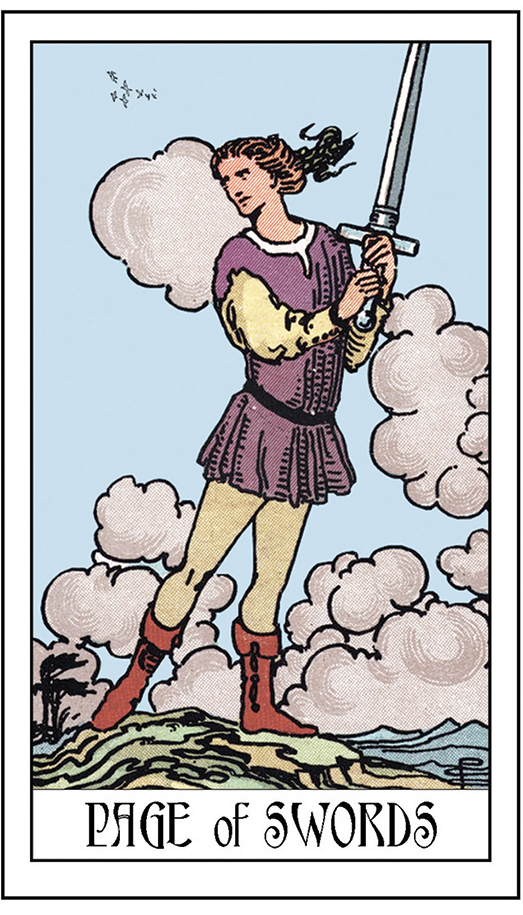
In the Rider–Waite–Smith image, the Page holds an upright sword while looking to the side. Wind moves through the landscape and clouds gather overhead. The stance suggests readiness, but it can also look unsettled—as though the Page is responding before the full situation is clear.
Swords are commonly linked with thought, language, conflict and discernment. Pages often represent a beginning, a message or a learning stage. Together, these symbols can describe an active mind: eager to understand, quick to notice changes and still developing judgment about when and how to respond.
Upright Page of Swords meaning
An upright Page of Swords can be a prompt to investigate. A new subject, conversation or piece of information may deserve careful attention. The card favors useful questions, research and intellectual honesty. It does not promise that the first explanation you hear is correct.
The challenging side is mental overactivity. Curiosity can turn into monitoring, rumor or argument when it loses respect for privacy and evidence. The practical task is to slow the gap between noticing something and deciding what it means.
Interpretation, not proof
A tarot card cannot verify another person’s thoughts, diagnose a health condition or guarantee an outcome. Use the image as a reflection prompt, then rely on direct communication, relevant evidence and qualified professional support for consequential decisions.
Reversed Page of Swords meaning
Reversed, the Page of Swords may highlight confusion, mixed messages or a plan launched before it was ready. It can also point to communication that is technically clever but needlessly cutting. Rather than labeling someone as dishonest, ask what information is missing and what can be checked.
This position can be constructive when it encourages revision: clarify the question, separate observation from assumption, and choose language that makes understanding more likely.
Past, present and future positions
Past
A period of intense learning, questioning or watchfulness may still shape how you interpret current events. Consider which earlier conclusions remain useful and which need updating.
Present
Gather information before committing to a story. Ask direct questions, check sources and notice whether urgency is helping or merely increasing tension.
Future
Consider how you would prepare for new information or a challenging conversation. This position can help you explore a possible response; it does not establish what will happen.
As a person
The card may symbolize someone observant, outspoken or intellectually curious. Court cards are flexible archetypes, not reliable descriptions of a person’s age, gender or private intentions.
Love and relationships
For relationships, the Page of Swords can highlight questions, boundaries and the quality of communication. It may be useful to ask whether you are listening for understanding or only preparing a response. Avoid using a reading to infer a partner’s hidden feelings; consent and an honest conversation provide better information.
Work and study
This card fits research, training, writing and situations where details matter. It can encourage you to prepare, document decisions and ask for clarification. Its caution is against workplace gossip, reactive messages and presenting an early idea as a settled conclusion.
Money
In a financial context, the Page of Swords favors reading the terms, comparing sources and checking the numbers. It does not predict profit or loss. For investments, debt, taxes or contracts, use current documentation and qualified financial or legal advice.
Well-being and spirituality
As a reflective prompt, the card may ask how information affects your stress and attention. A pause from constant alerts, journaling or a grounded conversation may help you sort facts from fears. Tarot cannot assess mental or physical health; contact an appropriate clinician when you need health guidance.
Spiritually, the Page can support beginner’s mind: remain curious, test interpretations gently and allow your understanding to change.
Questions for reflection
- What have I observed directly, and what am I assuming?
- Which source could confirm or challenge my current view?
- How can I communicate clearly without becoming combative?
- Am I respecting another person’s privacy and right to choose?
- What would a thoughtful next step look like after the urgency passes?
Page of Swords: yes or no?
The Page of Swords is not a dependable binary answer. If you use it in a yes-or-no spread, treat it as “gather more information first.” Reframe the question around an action you control, such as what to verify, whom to ask or how to prepare.
Page of Swords in a reading: an example
Imagine a tarot symbol catches your attention and you wonder whether it appears elsewhere in the deck. The Page in a position about learning might encourage comparing several cards and noting what actually changes. The Ace of Swords helps form the question; the Hermit supports focused study. Curiosity becomes richer when you explain your observation before reaching for a quick conclusion.
Try it in your own reading
Begin with I notice, then add I wonder. The first sentence anchors the image; the second gives your intuition somewhere to explore.
Frequently asked questions
What are the Page of Swords keywords?
Common themes include curiosity, vigilance, questions, messages, direct communication and mental restlessness. Context and the surrounding cards can change the emphasis.
What element is associated with the Page of Swords?
The suit of Swords is traditionally associated with air, often used to symbolize thought, language and discernment.
Does the Page of Swords mean someone is spying?
Some readers associate the card with watching or gathering information, but it cannot prove that a specific person is monitoring you. Use verifiable evidence and appropriate privacy or safety measures if you have a real concern.
Explore Page of Swords in A. E. Waite, The Pictorial Key to the Tarot.
The analysis of the Page of Swords card indicates a need for balance in various aspects of one’s life. It suggests self-awareness, particularly in personal relationships and work environments. The emphasis on inner reflection is crucial.
The commentary on the Page of Swords’ influence on health and spirituality is particularly thought-provoking. Focusing on mental health and spiritual growth aligns well with the card’s broader themes of introspection and self-improvement.
The detailed breakdown of the Page of Swords across past, present, and future contexts is informative. It highlights how the card’s energy can manifest differently depending on one’s situation and state of mind.
The connection between overbearing attitudes and the need for personal growth is well-articulated in this analysis of the Page of Swords. It serves as a reminder to be mindful of how one’s actions influence others.
The article provides a comprehensive overview of the Page of Swords. It’s interesting how the card’s message varies across different life areas, from career to love and friendships. The interpretation in the reverse position also adds valuable insights.