

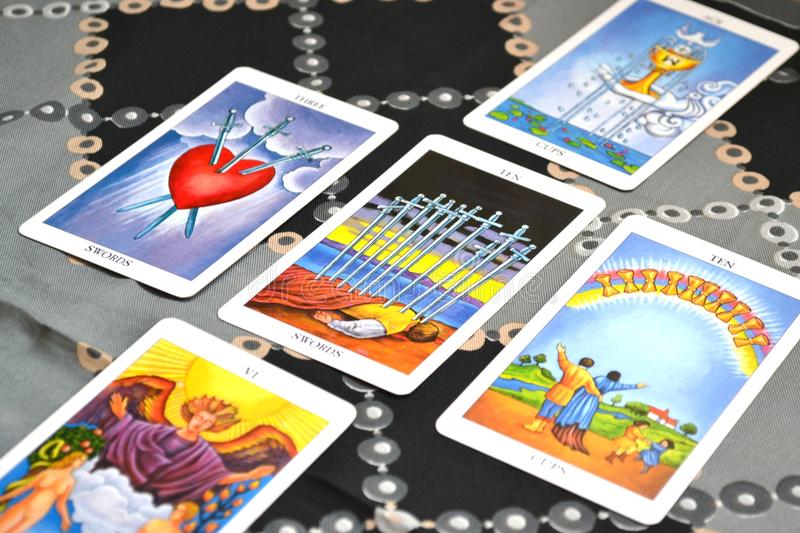
Five cards · From situation to next step
This five-card spread gives a goal more structure without pretending to reveal a single correct path. It separates your current situation, available support, a challenge, an action and a working definition of progress.
Lay out the cards
Lay five cards in a horizontal row and read them from left to right. Write the five position labels before drawing.
Card 1
Current situation
What part of the situation deserves a closer look?
Card 2
Available support
What skill, person or resource might help?
Card 3
A challenge to examine
What obstacle is supported by evidence, and what am I assuming?
Card 4
A next step
What small, realistic action could I consider?
Card 5
Progress to look for
What observable change would count as useful progress?
A worked example
For learning a new subject, the Page of Pentacles in support might suggest beginner-friendly practice. The Ten of Wands as a challenge could prompt a workload review. Neither card establishes your ability or guarantees the result.
What this spread cannot establish
These positions are a contemporary reflective version, not a universal five-card rule. The final card is a prompt for defining progress, not a promised outcome.
Turn the reading into a useful note
Turn the fourth position into one action and the fifth into a way to review it. If no interpretation fits, record that honestly instead of forcing a connection.
Will moving a card ruin the reading?
No. There is no need to fear a handling mistake. Keeping the original positions simply makes your notes consistent; if you restart, note that you did.
Read the five positions as a developing conversation
Five cards offer enough room for a central theme, influences and a possible response without becoming difficult to follow. Keep the position names beside the cards as you read. A card in a support position may have a different role from the same card in a challenge position. The Five of Wands as support could invite lively collaboration; as challenge, it might ask how competing approaches are affecting the group.
Finish with a synthesis, not five disconnected meanings
Describe the central issue in one sentence, add the strongest influence and name the response you want to consider. Check that your summary comes from the layout rather than from one striking card. You can circle a pair that deserves more thought, but let the five-card reading stand before deciding whether clarification is needed.
The detailed explanation of the five-card spread in this article is quite insightful. It’s interesting how each card represents different aspects of one’s life, from current state to future goals. The emphasis on maintaining an open mind while interpreting the cards is crucial.
The breakdown of the different suits in the tarot deck and their meanings is very well done. The Suit of Swords, Pentacles, Cups, and Wands each bring their unique elements to a reading, making the entire process comprehensive and multifaceted.
The article offers good advice on starting with an open mind and being patient while learning the meanings of different cards and suits. The practical steps provided for a basic five-card spread are useful for someone new to tarot reading.
I appreciate the explanation of the Major Arcana and its distinction from the Minor Arcana. Understanding the symbolic journey of the Fool and how it relates to life events adds depth to tarot reading.
This article provides a thorough overview of the five-card spread, including how to lay out the cards and interpret their positions. The suggestion to keep a journal of one’s readings to track progress and interpretations over time is practical and beneficial.