

Pentacles · Earth · Minor Arcana
The Three of Pentacles brings attention to what people can build together when each contribution is respected. In a reading, it often represents useful skills, constructive feedback and the early results of coordinated effort. Its central question is practical: how will the work be organized, and who needs to be heard?
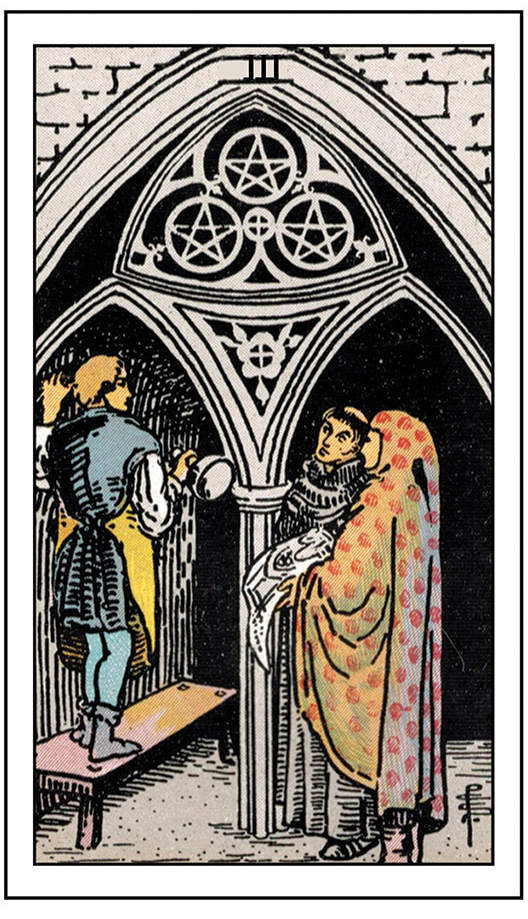
Upright
Collaboration, craftsmanship, learning from feedback and a shared standard of quality.
Reversed
Unclear roles, competing priorities, poor communication or work that needs revision.
A question to explore
What would help this group turn different skills into a workable plan?
Imagery and symbolism
In the Rider–Waite–Smith image, a craftsperson works within a stone building while two other figures consult nearby. The setting connects individual ability with a larger undertaking. The pentacles are integrated into the architecture: the work has a visible place and purpose. The scene supports a modern reading about collaboration, though different decks and reading traditions may emphasize recognition, skilled labor or apprenticeship.
Three of Pentacles upright
Upright, the card can encourage you to bring a developing skill into a setting where it can be used and assessed. You do not have to know everything before contributing. You do need to understand the brief, ask questions and respond to useful feedback. In a group project, this may mean agreeing on deliverables, deciding who owns each task and scheduling time to compare progress.
Three of Pentacles reversed
Reversed, the card can describe the frustration of working hard without working together. A team may have capable people but no shared definition of success. Consider whether the obstacle is missing information, an unrealistic deadline, unequal credit or disagreement about the method. A short conversation about roles may help more than another round of individual effort. The reversal is an invitation to inspect the process, not a verdict on anyone’s worth or competence.
Love and relationships
Relationships also involve shared work. This card can prompt a conversation about household responsibilities, plans and the everyday ways people support one another. Ask whether both people have a voice and whether commitments translate into action. For someone dating, shared activities can reveal how communication and cooperation actually feel. The card cannot establish another person’s feelings or promise that a relationship will last.
Work and study
At work or in study, make the connection between your effort and the standard being requested. Ask for examples of a successful outcome, seek feedback early and record decisions after a meeting. Recognition is one possible theme, but a card does not guarantee a promotion, grade or pay rise. Concrete evidence of your contribution makes a stronger basis for those discussions.
Money and practical decisions
Use the teamwork theme to clarify a shared budget or the terms of a project. Who pays for which costs? How are contributions, ownership and income recorded? Verify the numbers and agreements before committing. Pentacles imagery is not evidence that money is about to arrive or that a financial difficulty can be ignored.
Past, present and future positions
Past
Look back at an apprenticeship, group effort or piece of feedback that shaped how you work with others. What did you learn about asking for help?
Present
Clarify the task and invite input from the people doing it. A useful contribution may be a question that reveals a missing requirement.
Future
Consider what collaboration would require if the project continues: time, skills, agreements and ways to resolve differences. This is a planning prompt rather than a promised result.
Let your contribution become part of something shared
The Three of Pentacles celebrates the meeting of different gifts. Spiritual growth can happen through listening, accepting constructive feedback and allowing another person to bring knowledge you do not have. Being part of a team does not diminish your individuality; it gives your skills a useful setting.
How it differs from nearby cards
The Eight of Pentacles emphasizes repeated practice; the Three places skill in a shared setting. The Six of Pentacles raises questions about giving, receiving and the balance of resources. Comparing these cards can help distinguish learning a task, coordinating it and supporting the people involved.
Try this reflection exercise
- Name one shared task and the outcome everyone is trying to achieve.
- List the skills or resources each person can offer; check the list with them.
- Choose one point where feedback would be useful before the work is finished.
- Agree on the next small action and who will take it.
Three of Pentacles in a reading: an example
Picture three neighbors creating a community garden. One knows soil, another can build planters and a third organizes volunteers. In a position called what supports us, this card could suggest agreeing on the plan before anyone starts digging. Beside the Eight of Pentacles, it highlights the skill each person develops; beside the Three of Cups, it adds the enjoyment of belonging. A good reading distinguishes friendly enthusiasm from the practical coordination that lets the project grow.
Try it in your own reading
Ask who needs to see the next draft, what kind of feedback would help and how you will acknowledge their contribution.
Frequently asked questions
Does the Three of Pentacles mean a third person is involved in a relationship?
The three figures can suggest a group or shared undertaking, but they do not prove infidelity or identify a third party. If you have a relationship concern, use direct communication and evidence rather than treating the image as confirmation.
Explore Three of Pentacles in A. E. Waite, The Pictorial Key to the Tarot.
The article provides a comprehensive interpretation of the Three of Pentacles. It seems that this card emphasizes hard work and cooperation. However, it would be helpful to know how other cards might interact with the Three of Pentacles in a reading.
The breakdown of the Three of Pentacles across different aspects of life – past, present, future, work, love, etc. – is quite detailed. The insights could be very useful for someone seeking guidance in these areas.
The detailed analysis of the Three of Pentacles across various life domains is quite informative. The emphasis on hard work and setting a good example resonates well with the card’s symbolism.
It’s interesting how the Three of Pentacles touches on personal growth and self-improvement. The notion of being a role model and mastering your craft is a powerful message.
The article does an excellent job of explaining the different facets of the Three of Pentacles. Understanding its positive and reverse meanings adds depth to its interpretation.