

Major Arcana · XI
Justice brings evidence, fairness and responsibility into focus. It asks how a decision is reached and who bears its consequences. It does not predict a legal result or establish that suffering is deserved punishment.
Upright
Fairness, accountability, evidence and considered decisions.
Reversed
An unfair process, incomplete information or responsibility being avoided.
A question to explore
What would a fair decision require me to examine?
Imagery and symbolism
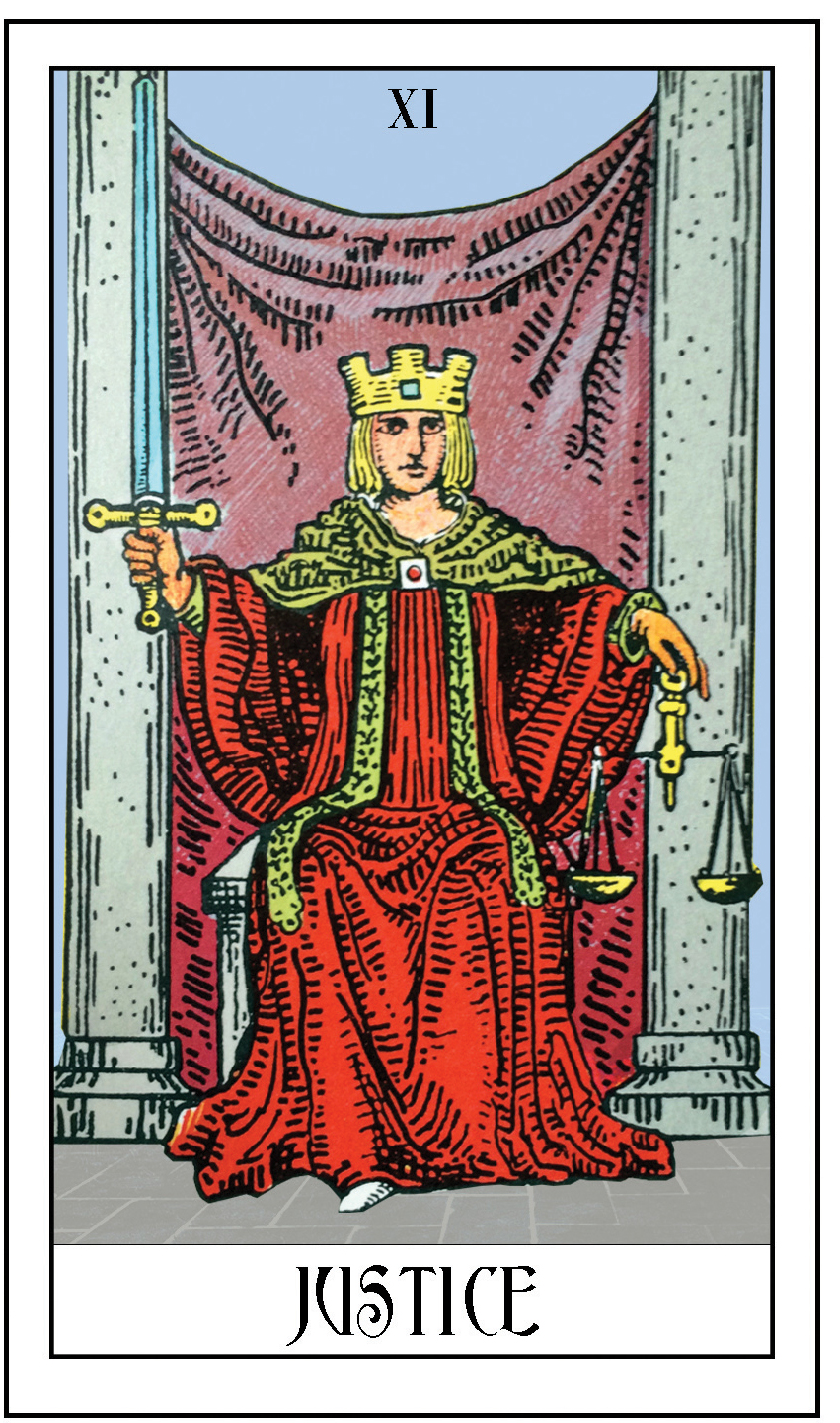
The Rider–Waite–Smith figure sits between pillars holding scales and an upright sword. The scales can suggest weighing relevant information; the sword can suggest a clear decision. This deck numbers Justice XI, while some tarot traditions use VIII.
Justice upright
Upright, define the issue and use a consistent standard. Distinguish what happened from what you infer about motives. Accountability can include correcting your own contribution without accepting responsibility for circumstances or actions that are not yours.
Justice reversed
Reversed, inspect the process: whose perspective is missing, which facts are uncertain and whether the same rule applies to everyone. Seek an appropriate review or advice when the issue has serious consequences. The card itself is not proof of dishonesty.
Love and relationships
Discuss reciprocity and agreements in specific terms. Fairness does not always mean identical contributions, but it should allow each person a voice. The card cannot decide whether to separate.
Work and study
Use clear criteria, documented expectations and an appropriate opportunity to respond. For a dispute, rely on the relevant procedures and qualified guidance rather than a tarot verdict.
Money and practical decisions
Review obligations and records. Justice does not guarantee compensation, repayment or a favorable court decision. Legal and financial matters require real-world evidence and suitable advice.
Past, present and future positions
Past
Consider a decision and its consequences without rewriting the facts to fit a moral story.
Present
Gather the information and perspectives needed for a fair assessment.
Future
Plan a transparent process instead of predicting a favorable ruling.
Bring the same care to the process and the result
Justice invites balance, responsibility and honest consideration. Its spiritual value can be the alignment between what you believe is fair and how you act when a decision affects others. Taking time to hear the relevant perspectives can be an expression of integrity.
How it differs from nearby cards
The King of Swords emphasizes reasoned authority; Justice emphasizes fairness in the decision and its consequences. Judgement turns toward review and response to what has been learned.
Try this reflection exercise
- State the question without assigning blame.
- List the relevant facts and missing perspectives.
- Choose a fair next step or an appropriate source of advice.
Justice in a reading: an example
Suppose two friends disagree about how to divide the costs of a shared event. Justice in a position about resolution might suggest revisiting the original agreement and discussing any change openly. The Six of Pentacles considers the exchange; the King of Swords helps make the reasoning clear. Fairness becomes practical when everyone understands what is being decided and why.
Try it in your own reading
Ask what information would change your view and whether you would accept the same rule if the roles were reversed. These questions can clarify the principle behind your preference.
Frequently asked questions
Does Justice mean I will win a court case?
No. Tarot cannot reliably predict legal outcomes. Consult a qualified professional about the facts, procedures and options in your situation.
Explore Justice in A. E. Waite, The Pictorial Key to the Tarot.
The interpretation of the Justice card as being neither inherently positive nor negative resonates with the essence of balance and fairness. It serves as a reminder of the importance of accountability in one’s actions.
The concept of karma tied to the Justice card is particularly thought-provoking. It underscores the notion that our actions, whether good or bad, inevitably return to us in some form.
The varied implications of the Justice card in different time positions—past, present, and future—illustrate its dynamic nature. It seems to encourage a constant evaluation of one’s decisions and their long-term effects.
Indeed, Rapunzel. The card’s focus on decision-making across time highlights the importance of being mindful of our choices and their potential consequences. It’s a reminder that we are constantly shaping our future.
I agree with both of you. The Justice card’s emphasis on balance and truth across different aspects of life is a call for introspection and ethical living. It challenges us to consider the fairness of our actions.
The delineation of Justice across different life aspects—such as love, friendship, and finances—provides a comprehensive understanding of how this card can manifest in various scenarios. It’s intriguing to see how a single card can have multiple layers of meaning.
I appreciate the connection drawn between the Justice card and the astrological sign Libra. Both emphasize equilibrium and fairness, reinforcing the card’s core message.