Major Arcana · XIII
Death is commonly read as a symbol of endings, transition and changing forms. Its dramatic name does not make it a prediction of physical death, illness or catastrophe. Begin with what is actually ending or changing in your situation, not with the most frightening possibility.
Upright
An ending, transition, release and a changed way of continuing.
Reversed
Resistance to change, unfinished closure or a gradual transition.
A question to explore
What is genuinely ending, and what support would help me adapt?
Imagery and symbolism
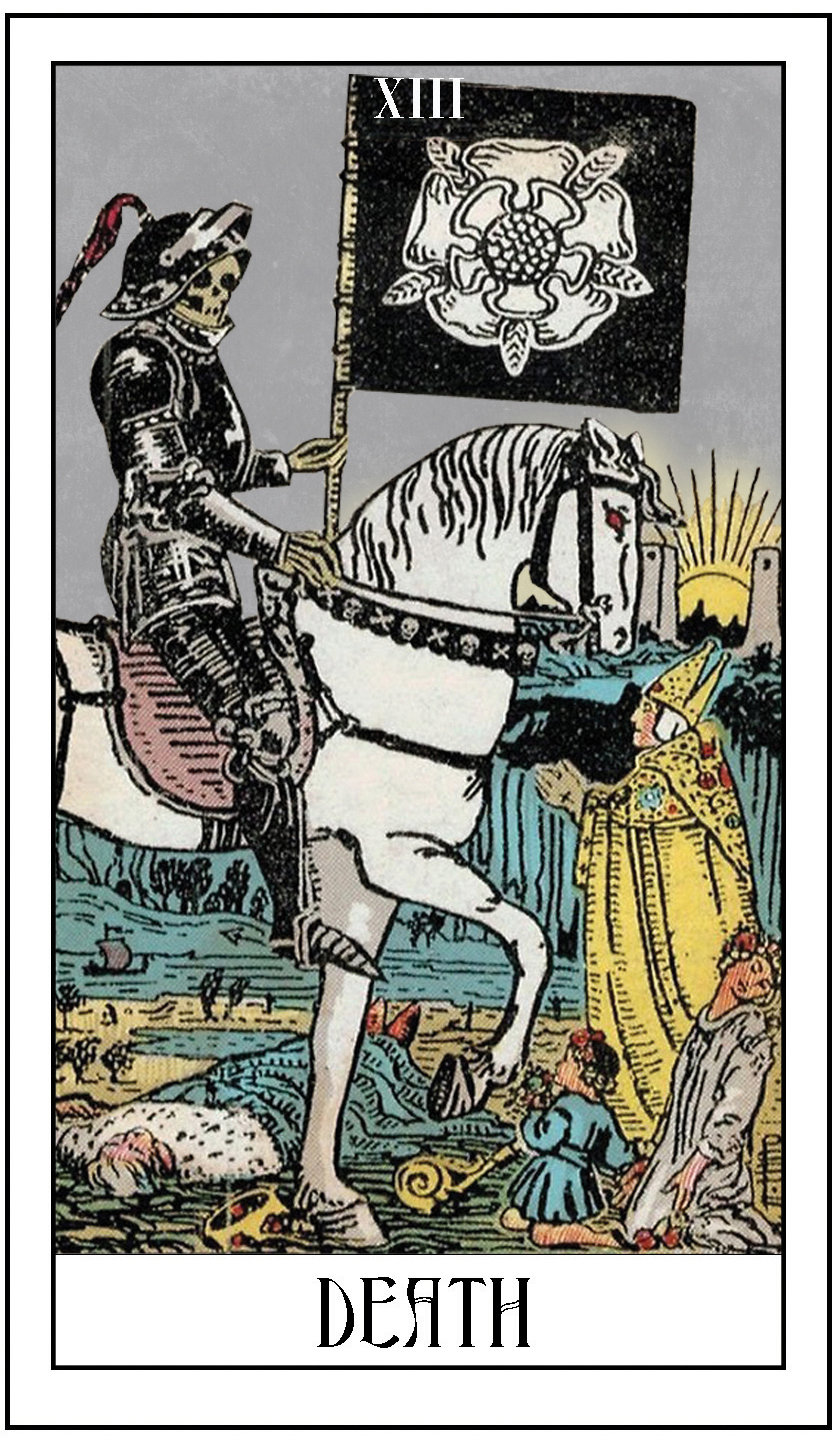
The Rider–Waite–Smith image shows an armored skeletal rider carrying a black banner with a white rose. People of different ages and positions meet the rider, while light appears between distant towers. Waite discusses transformation and passage; contemporary readers often use the scene to explore change and renewal.
Death upright
Upright, name the specific ending rather than declaring your whole life over. A role, routine or expectation may no longer fit. Acknowledge what mattered before considering what becomes possible next; you do not have to find a positive lesson immediately.
Death reversed
Reversed, look for an unfinished practical task or an expectation that is difficult to release. Change can be slow, and reluctance may contain useful information. The card does not justify forcing yourself or another person through a transition.
Love and relationships
A relationship may change its habits without ending, or an ending may need to be accepted. Discuss observable circumstances; the card cannot decide another person’s intentions or require reconciliation.
Work and study
Prepare for changes in a project or role with a handover, updated plan or realistic search. Do not resign solely because this card appears.
Money and practical decisions
Review commitments that no longer serve your needs. Use actual balances, terms and qualified advice for significant decisions rather than treating the card as a forecast of loss.
Past, present and future positions
Past
Reflect on an ending that changed your expectations.
Present
Name what has changed and what still remains available.
Future
Plan for adaptation without assuming a particular loss will occur.
Honor what is ending and prepare what comes next
Death in tarot can offer a powerful language for transition and renewal. Its invitation may be to acknowledge a chapter fully enough that your energy can return to the life developing beyond it. A meaningful ending can include gratitude, grief and a practical act of release.
How it differs from nearby cards
The Tower highlights disruption, while Death often centers the transition itself. The World emphasizes completion and integration rather than the process of letting go.
Try this reflection exercise
- List what is ending, what is continuing and what is uncertain.
- Choose one practical task that would reduce the strain of transition.
- Name a person or resource you can approach for support.
Death in a reading: an example
Suppose you are closing a creative business that no longer fits your interests. This card in a position about transition could encourage preserving the work you value, finishing outstanding arrangements and choosing what to carry into your next project. The World marks completion; the Ace of Wands suggests a new spark. The reading can support a thoughtful passage between chapters without requiring you to rush into the next one.
Try it in your own reading
Choose a simple closing ritual: archive the work, thank the people involved or write what the chapter taught you. Let the ritual accompany practical completion.
Frequently asked questions
Does drawing Death mean someone will die?
No. A tarot card is not evidence that someone will die. Read it symbolically, and address health or safety concerns through appropriate real-world support.
Explore Death in A. E. Waite, The Pictorial Key to the Tarot.
It was interesting to read how the Death card isn’t about a literal death but more about an ending that leads to new beginnings. The breakdown across time frames (past, present, future) and life areas gives a holistic view of its significance.
The interpretation of the Death card encompassing elements such as work, love, and health, provides a well-rounded understanding of its symbolic nature. Notably, the explanation about its astrological association with Scorpio adds an intriguing layer of depth.
The analysis of the Death card is quite comprehensive. It appropriately covers various aspects of life such as work, love, and health, highlighting the transformative nature of the card. The metaphoric interpretation rather than a literal one is a refreshing reminder of the cyclical nature of life.
The detailed description of the Death card shows how deeply it can impact various areas of life. It seems to encourage a mindset of accepting change and preparing for new opportunities, which is a positive outlook.
This article provides a balanced perspective on the Death card by acknowledging the inevitability of change and transformation. The detailed depiction of its implications in different life areas can be quite useful for those who are new to tarot readings.