
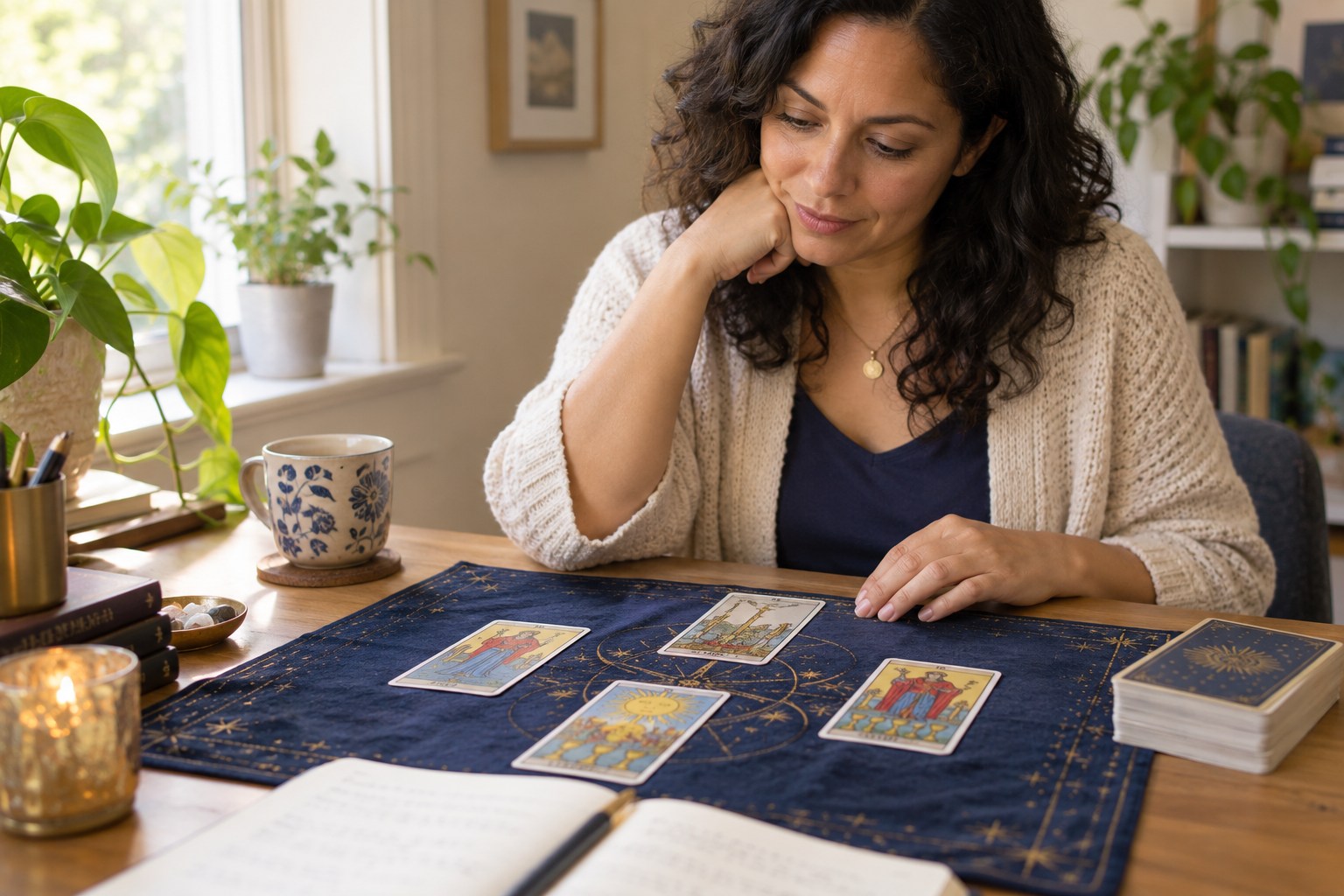
Self-reflection can begin with a detail rather than a sweeping question about who you are. A figure standing apart from a group, an unopened path or a cup held carefully may bring a familiar feeling into focus.
You can approach tarot through a spiritual practice, personal intuition or curiosity about the pictures. Describe what you see and connect it with a situation you can name. The goal is a useful question and a considered next step, rather than handing the cards control of your life.
Let the image name something you have not yet put into words
Your response does not have to match every traditional keyword to be worth exploring. Write two interpretations of the same image, one about a strength and one about a need. A solitary figure might suggest welcome independence or a wish for company. Ask which reading fits the situation you actually brought to the cards.
This gives intuition room to unfold while keeping the reflection specific enough to use. If an interpretation does not fit, write that down. Consider an alternative without forcing a story. Your response can reveal a useful question, but it is not a clinical assessment or a recovered memory.
Choose a deck you can comfortably learn
Start with artwork you can see clearly, cards you can handle and a guidebook that explains the deck’s own system. Many beginners find a Rider–Waite–Smith-style deck convenient because its illustrated scenes support visual description, but it is not the only option.
A standard tarot deck has 78 cards: 22 Major Arcana and 56 Minor Arcana, with four suits within the latter. The V&A’s history of tarot also explains its earlier use as a card game. Oracle decks follow their creators’ own structures, so check their guidebooks rather than assuming the same numbering or suits.
You do not need an expensive deck or a special journal. A private phone note, voice memo or plain notebook can hold the reflection. Our first-deck checklist offers more practical considerations.
Three exercises, from one card to three
1. One card: notice and ask
Question: what part of today’s situation deserves my attention?
Describe one visible detail, name the association it brings up and turn it into an open question. You can stop there; another card is not required.
2. Two cards: present response and chosen action
Positions: how I am approaching this; what response I could try.
The first card is a prompt to examine your mindset, not a measurement of your energy. The second suggests possibilities for action rather than an order.
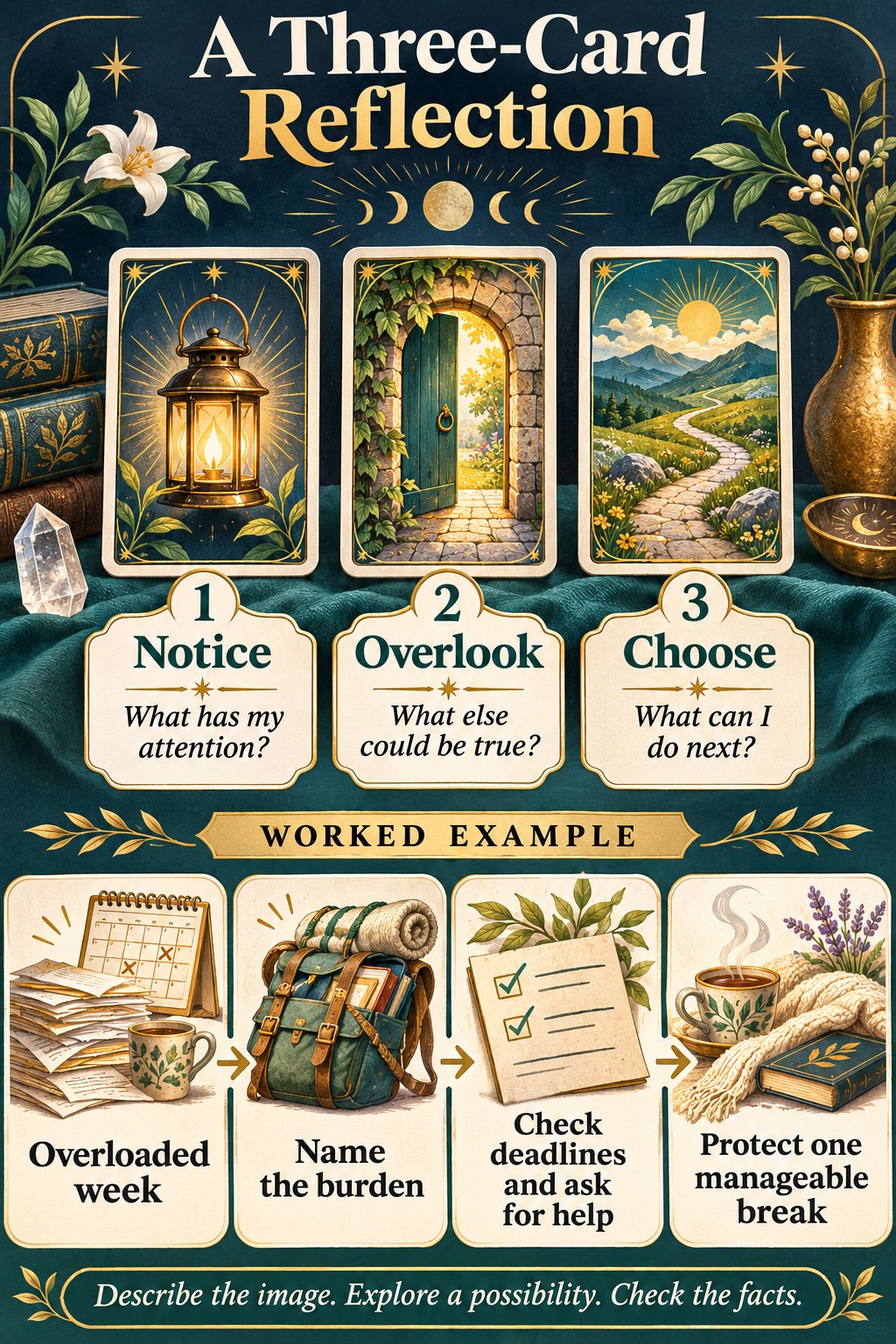
3. Three cards: notice, overlook, choose
Use three clear positions: what I am noticing, what I may be overlooking, and what I can choose next. Describe each card before interpreting it. Keep the exercise connected to one situation rather than asking the deck to explain your entire life.
Other useful three-part arrangements include a strength, a need and a next step; a hope, a concern and a question to investigate; or head, heart and practical circumstances. State the positions before drawing so you are less tempted to change their meaning to fit the cards.
A worked example: the day feels overloaded
Suppose your question is how to approach an already crowded week. You draw the Ten of Wands and the Four of Swords. In many Rider–Waite–Smith-style images, the first shows a burden of wands and the second a resting figure. Your deck’s artwork may differ.
- Observation: carrying a large load; a figure at rest.
- Possible interpretation: I may be treating every task as mine and need a pause.
- Reality check: which deadlines are fixed, which tasks can be shared and what rest is possible?
- Chosen action: ask for help with one task and protect one manageable break.
The cards did not establish your schedule or tell you to ignore a responsibility. They gave you a way to examine the situation. A card about loss might similarly prompt acknowledgment of disappointment; a card about resources might prompt an inventory.
Free tarot self-reflection log
Copy these headings into a private note for each exercise.
- Situation: one sentence about what is happening.
- Question and positions: written before drawing.
- Cards and visible details: what the artwork actually shows.
- First association: a feeling, memory or idea it brings forward.
- Another interpretation: a different reading, or “this does not fit.”
- Information I need: facts to check outside the reading.
- My next step: a small action within my control.
- Later review: what happened and what I learned, including where the interpretation was unhelpful.
Review the full record rather than keeping only striking matches. You can learn about your habits without claiming the deck predicted every outcome.
A short meditation with the image
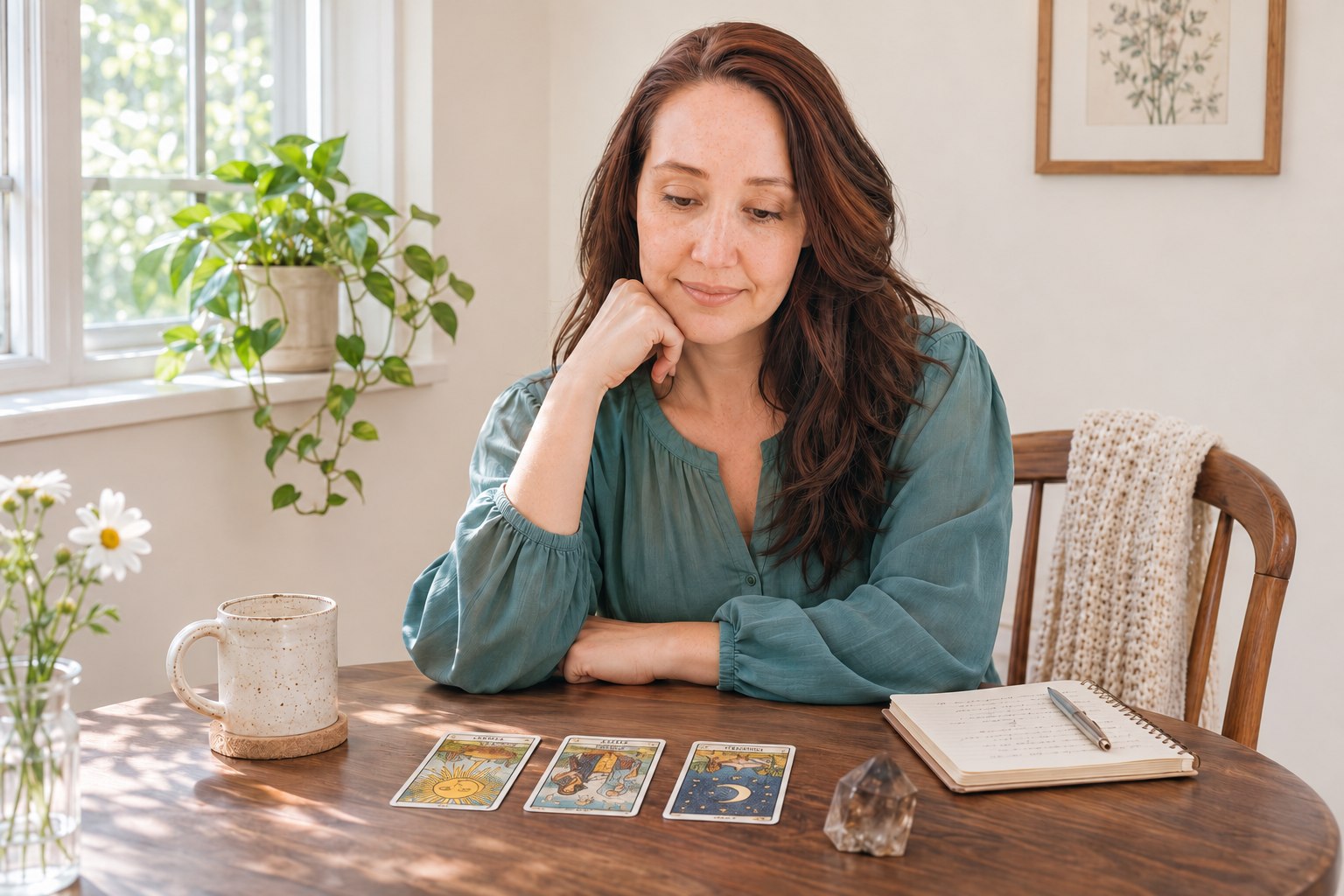
Look at one detail for a comfortable moment, with no requirement to stare or hold a special posture. Notice gesture, color and the relationship between figures. If imagining a conversation with a character helps, keep it clearly as an imaginative exercise.
You can use the short tarot meditation guide for another approach. Stop if the practice becomes uncomfortable; longer is not automatically more meaningful.
Bring reflection back to your own life
A difficult card does not announce doom. Death, the Tower or another strong image can invite a question about endings, disruption or change without predicting a literal event. Read the card in context and allow yourself to disagree.
Use the tarot question bank when you need a clearer prompt. For a different angle, explore your first associations or the inner-clarity spread. Choose a next step that makes sense from your circumstances, whether or not the image feels profound.
Frequently asked questions
1. Can I use tarot for self-reflection without predicting the future?
Yes. You can use the images as prompts for questions, associations and choices without treating them as fixed forecasts.
2. Do I have to be psychic to begin?
No. You can start by describing the artwork, reading the deck’s guidebook and considering how an image relates to your situation.
3. How many cards should I draw?
One card is enough to begin. Two or three can help if you choose clear positions before drawing. More cards are not automatically clearer.
4. What is a useful one-card question?
Ask what part of a specific situation deserves your attention. Turn one visible detail into an open question.
5. What does the two-card exercise cover?
It explores your present approach and a response you could try. Neither card is a measurement or an instruction you must follow.
6. What are the three-card positions?
What I am noticing, what I may be overlooking and what I can choose next. Keep all three connected to one named situation.
7. Must my interpretation match the guidebook exactly?
You can consider both the deck’s conventional meanings and your own associations. Be clear about what comes from each.
8. What if the card does not fit?
Record that response rather than forcing a match. You can consider another interpretation or leave the card unresolved.
9. Does the Death card predict a literal death?
It does not establish that a death will occur. Explore the image in context rather than treating a dramatic title as a forecast.
10. Can tarot diagnose my emotions or health?
No. A card can prompt reflection about how you feel, but it is not a clinical assessment or a way to establish a health condition.
11. How is an oracle deck different?
Oracle decks follow their creators’ own structures and guidebooks. They do not have to use tarot’s standard 78-card system.
12. Do I need a special tarot journal?
No. A private phone note, voice memo or ordinary notebook can hold your observations and later review.
13. What belongs in the free reflection log?
Record the situation, question, positions, visible details, associations, another interpretation, needed information, next step and later review.
14. Should I keep drawing until the answer feels positive?
Pause rather than chasing reassurance. Review the question and the facts you need, and allow an uncertain or unhelpful result.
15. How do I turn a reading into action?
Choose one small response within your control, check practical facts and review what you learned afterward.
The use of tarot cards for self-reflection seems to be a profound method for personal exploration. The detailed example of the Three Card Tarot Spread provides a structured approach to understanding oneself. This could indeed be a valuable tool for those seeking clarity in their lives.
The idea of journaling tarot readings over a lifetime intrigues me. It’s like creating a personal, evolving narrative with mystical undertones. Truly captivating if approached with an open mind.
Absolutely, Hubby! It’s like a mystical autobiography unfolding over time. Imagine the depth of insight one could gain!
While it sounds poetic, I worry about the potential for self-deception. Relying too much on tarot could lead to ignoring tangible, rational solutions to life’s challenges.
Oh, fantastic! Just what I needed—a daily ritual to tell me what I should already know about my life. Because a piece of cardboard obviously holds the key to all my existential dilemmas. What a revelation!
The notion of using tarot for introspection is quite fascinating. It seems like a structured way to reflect on one’s life, offering a unique perspective that’s often missing in mundane self-help methods.
The breakdown of tarot card spreads for self-reflection is quite informative. It gives a clear methodology for someone looking to delve deeper into their own subconscious thoughts and feelings.
I find the entire premise utterly nonsensical. Tarot cards predicting your future or providing any meaningful insight into your life is pure superstition, and it’s disheartening to see such medieval practices still being promoted.
The breakdown of each tarot card’s meaning in different contexts—past, present, and future—is quite informative. It offers readers a tangible way to apply these readings to their own lives. However, it would be beneficial to include more examples of different spreads.
The examples provided for interpreting specific cards are quite helpful in giving readers a clearer understanding of the possible messages the cards might convey. A more extensive guide on interpreting various cards could be a great addition to this resource.
The concept of using tarot cards to connect with spiritual guides is intriguing. This adds an additional layer of depth to the practice, making it not just about self-reflection but also about seeking external spiritual assistance.
I agree. Including spiritual guides can potentially enhance the reading experience. Perhaps future articles could elaborate on different methods to invite and recognize these spiritual entities.
Indeed, the involvement of spiritual guides can make the experience more enriching. It could be interesting to delve deeper into how one can effectively invite these guides into their tarot readings.
This article offers a well-rounded introduction to tarot card reading, especially for beginners. The emphasis on journaling outcomes over a lifetime is particularly insightful, as it allows for tracking personal growth and development over time.