Psychic.Cards · Reflection with perspective
Tarot may help some people slow down and put words to stress, needs or priorities. It cannot assess mental health, diagnose a condition, measure risk or determine which treatment is appropriate.
Keep the check-in kind and manageable
Choose a question that invites care, such as What would help me make this evening gentler? You might use the Four of Swords as a reminder to pause or the Queen of Pentacles as an invitation to make your surroundings more comfortable. The value lies in the response that feels supportive to you.
Set a small reading limit and keep the next step simple: prepare a comfortable place to sit, contact someone you trust or put a demanding task aside until a suitable time. Tarot is not a diagnosis or treatment. If the exercise increases distress, stop; ongoing mental-health concerns deserve support from a qualified professional.
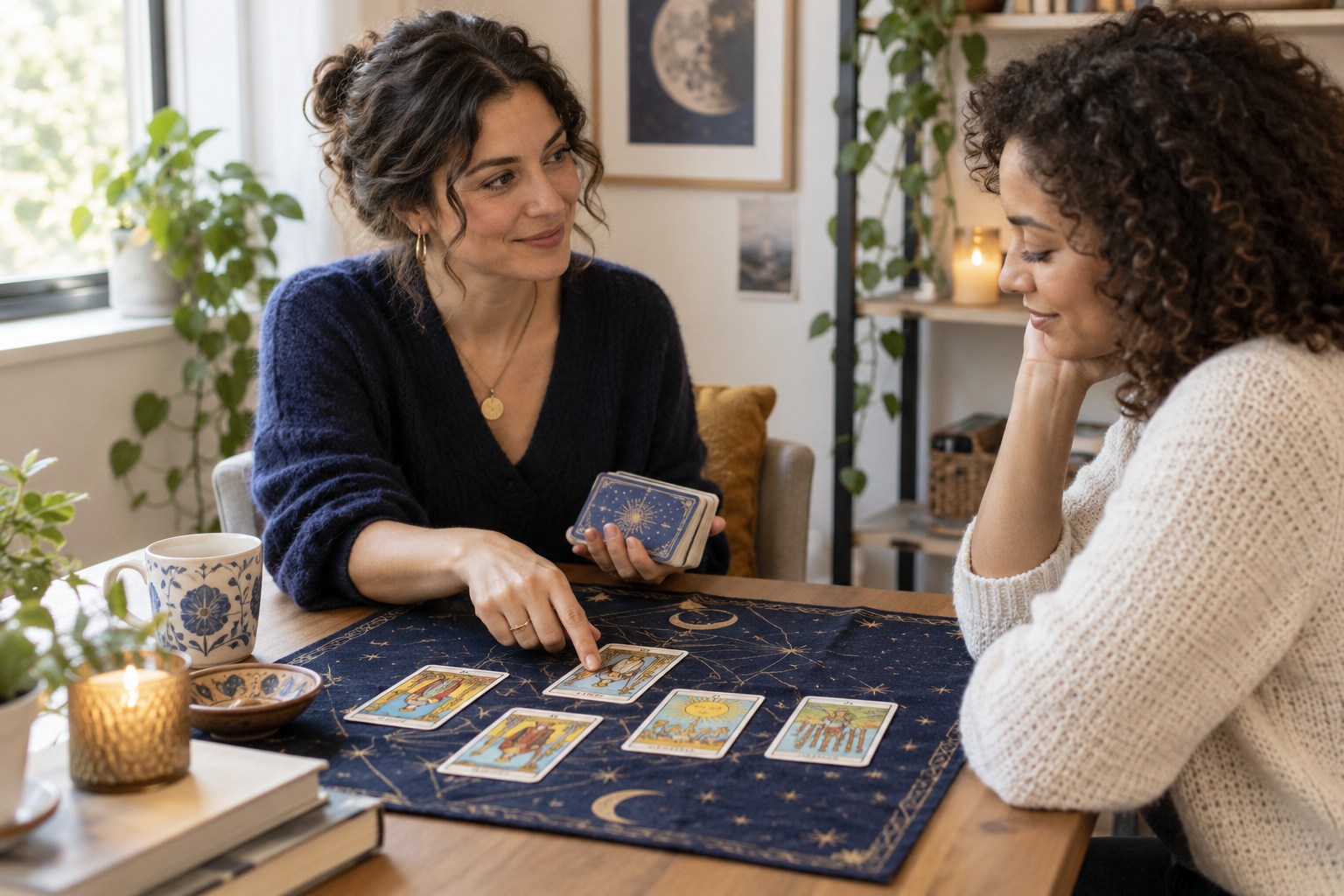
A card image can work like a journaling prompt: it may invite you to describe what feels demanding, what support you have and what small step is available. The useful information comes from your reflection—not from treating the card as a clinical test.
A five-card reflective check-in
Shuffle only if the ritual feels comfortable. Draw up to five cards and use each as a question rather than an answer.
- What am I noticing? Describe sensations, feelings and circumstances without diagnosing them.
- What is taking energy? Name a specific demand, conflict or uncertainty.
- What is supporting me? Identify a person, routine, place or resource that genuinely helps.
- What is one manageable step? Choose something concrete and within your control.
- What needs professional attention? Note any concern that should be discussed with a clinician or another qualified professional.
Keep the record grounded
Write the date, the card, your first association and the action you chose. When you review the entry later, ask whether the action helped. This makes the exercise about observation and learning instead of proving that a card predicted your state.
The National Institute of Mental Health explains that self-care can support well-being and treatment, and recommends seeking professional help for severe or distressing symptoms that persist. Its current guidance is available at Caring for Your Mental Health.
What tarot should not be asked to do
- decide whether you have a mental-health condition;
- tell you to begin, stop or change medication or treatment;
- replace a safety plan or crisis support;
- prove that another person caused your symptoms spiritually; or
- promise recovery on a particular timeline.
If the exercise increases fear, compulsive checking or distress, stop. Put the cards away, reconnect with ordinary surroundings and reach out to someone qualified to help.
Choose a stop rule before you draw
Set a short time limit and decide that one draw is enough. If the image increases distress, put it aside; you do not need to solve it. Record a concrete support option—such as contacting a clinician or trusted person—rather than assigning another card to decide whether help is deserved.
For health support, see NIMH’s guidance on caring for your mental health. Tarot is not a clinical assessment.
‘You are the light you’ve been searching for’? Wow, such deep wisdom! 🙄 If only it were that simple! Life’s complexities can’t just be solved by pulling cards; maybe try some real-world solutions instead!
Honestly, I find it hard to believe that tarot can really help with mental health. While I understand the need for self-care, relying on cards sounds a bit too mystical for me. Can’t we just seek professional help instead?
The concept of using tarot cards as a mental health check-in is fascinating! Who would have thought? But honestly, do you really think shuffling cards can replace actual therapy? Seems like a stretch to me! 🤔
*sigh* Another article telling us to pull out our cards when feeling down. How about we just grab some snacks and binge-watch our favorite shows? That sounds way more effective than introspection! 🍕📺
I can’t believe people are seriously considering tarot readings as legitimate mental health tools. 😂 Next, they’ll tell us that crystals heal broken hearts! Let’s get real—professional help is what we need!
I absolutely loved this article! 🌟 It’s so refreshing to see mental health discussed so openly. The idea of using tarot as a tool for self-care is brilliant and truly resonates with me. We should all prioritize our mental well-being!
“When life feels like a waiting room…” What an insightful metaphor! It’s true—many of us go through phases where we feel lost or in transition. This article highlights the importance of self-reflection, which can be facilitated through various means, including tarot.
This article provides valuable insights into the importance of addressing mental health issues. It’s crucial for people to realize that they are not alone in their struggles and that tools like tarot can serve as an interesting form of reflection and support.