
Swords · Air · Minor Arcana
The Five of Swords asks what a victory costs. Conflict, humiliation and damaged trust are common contemporary themes. The useful question is not who a card declares guilty, but whether the way a disagreement is being handled is making the situation worse.
Upright
Conflict, a hollow victory, damaged trust and the cost of winning.
Reversed
De-escalation, unresolved resentment or a need to repair harm.
A question to explore
What outcome matters more than having the last word?
Imagery and symbolism
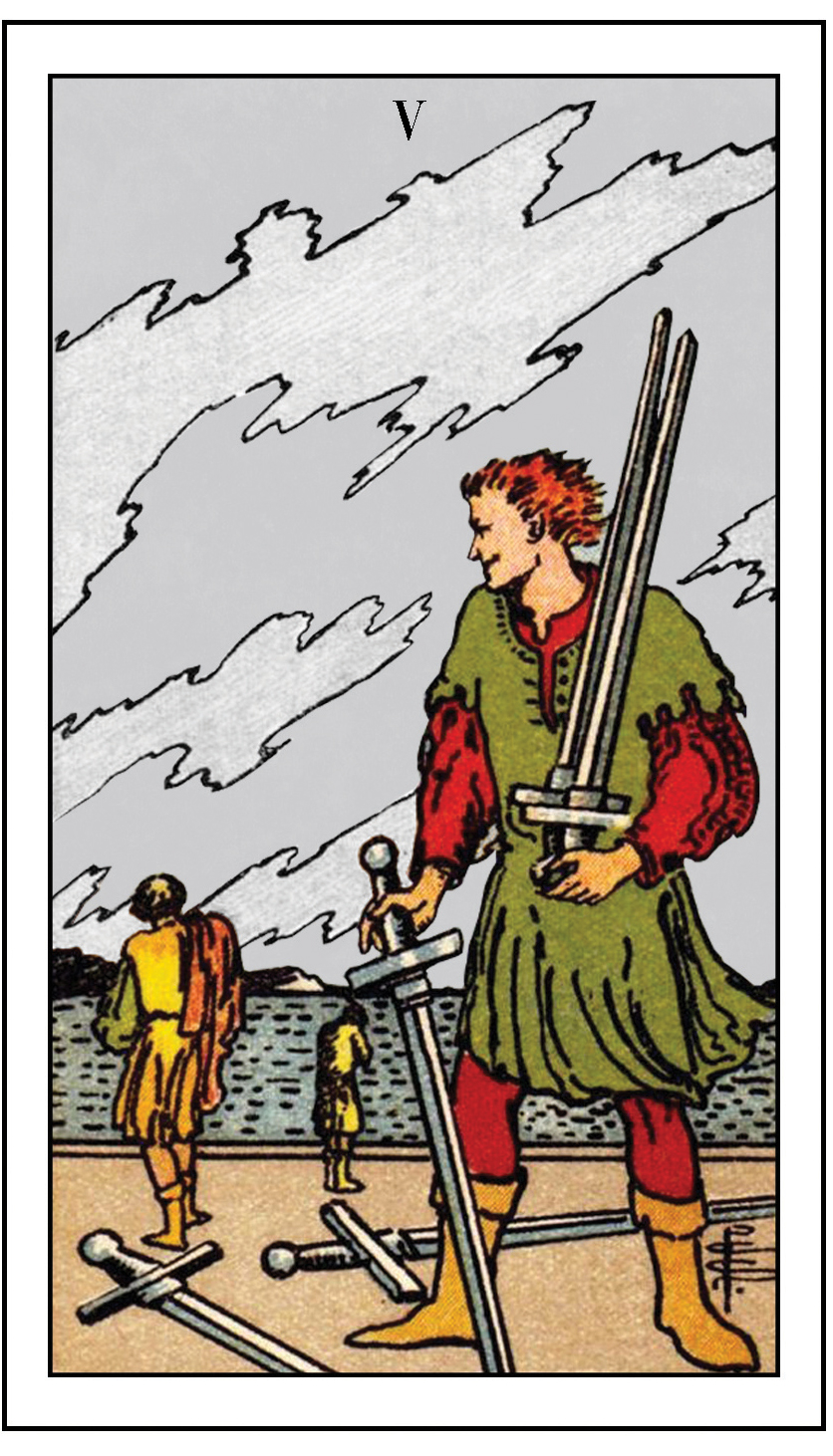
A foreground figure gathers swords while others turn away in the Rider–Waite–Smith scene. The unequal positions and abandoned weapons suggest an aftermath rather than cooperative resolution. The image allows questions about winning, losing and disengaging without identifying anyone in your life.
Five of Swords upright
Upright, look at the process of an argument. Are people addressing the issue, or trying to embarrass each other? Winning a point may leave the original problem untouched. A boundary, a pause or help from a suitable third party can be more useful than another round.
Five of Swords reversed
Reversed, consider whether an apology or agreement has changed behavior. Repair requires more than declaring the conflict over. You do not have to resume contact or accept blame that is not yours to create a tidier ending.
Love and relationships
In relationships, focus on actual patterns of communication and respect. The card cannot prove an affair or predict a fight. If there is coercion or a threat to safety, prioritize support and safety rather than trying to win or mediate the disagreement.
Work and study
Document concrete incidents and use appropriate workplace or school channels for serious concerns. Ordinary disagreement and bullying are not interchangeable; do not normalize harmful treatment as necessary growth.
Money and practical decisions
Do not make a costly choice merely to win a comparison or dispute. Check what is at stake, your obligations and the available advice. The card is not evidence that someone is stealing from you.
Past, present and future positions
Past
Consider how a past conflict shaped your expectations of disagreement.
Present
Ask whether your current approach is moving toward resolution or simply escalation.
Future
Plan boundaries and a way to disengage where appropriate. Conflict is not inevitable because of this position.
Ask what remains after someone wins
The Five of Swords can bring attention to the cost of an argument. Its invitation is to step beyond proving a point and consider what kind of relationship or shared space you want afterward. Choosing a different approach can be an expression of strength and self-respect.
How it differs from nearby cards
The Five of Wands can evoke competing efforts; the Five of Swords more sharply raises the cost of conflict. The Six of Swords shifts toward transition and distance.
Try this reflection exercise
- Name the issue without insults or assumptions about motives.
- Write the practical outcome you want.
- Identify one boundary or support channel that could reduce escalation.
Five of Swords in a reading: an example
Imagine a discussion in a hobby group becomes a contest over who knows more. In a position about the atmosphere, this card might encourage returning to the shared activity or ending the debate politely. The Five of Wands can represent vigorous exchange; the Five of Swords asks whether that exchange has become personally costly. The distinction helps you decide whether to clarify, repair or step away.
Try it in your own reading
Before your next reply, ask what result would actually help. Being understood, preserving a boundary and winning an argument are different aims.
Frequently asked questions
Does walking away mean losing?
Not necessarily. Disengaging may protect time, dignity or safety. Whether to continue depends on the real situation, not on winning a symbolic contest.
Explore Five of Swords in A. E. Waite, The Pictorial Key to the Tarot.
The article provides a thorough interpretation of the Five of Swords card, touching on various aspects like work, love, and health. It’s interesting to see how the card’s symbolism can be applied to different life areas.
I appreciate the balanced approach the article takes in discussing the Five of Swords. While it acknowledges the challenges, it also emphasizes the importance of preparation and seeking support.
The connection the article makes between the Five of Swords and numerology is quite intriguing. The energy associated with the number five seems to align well with the card’s themes of conflict and change.
The section on finances and the advice to save money in preparation for potential downturns is particularly practical. It’s a reminder to be cautious during uncertain times.
It’s notable that the article covers the Five of Swords in both its upright and reverse positions, offering a comprehensive perspective for those seeking guidance.