


To read tarot reversals, begin with the card’s upright theme, apply one chosen reversal method and keep the spread position in view. An upside-down image does not automatically mean the opposite or signal a disaster.
Reversals are optional. You can learn upright meanings first or use positions to explore challenges without reversing cards. Choose the convention before the draw and keep it consistent.
Possible reversal lenses: choose one method
| Lens | What it explores | Example question |
|---|---|---|
| Difficulty expressing a theme | What makes the upright quality hard to use? | What would make cooperation easier? |
| Inward focus | How might the theme be private or internal? | What am I practising before sharing it? |
| Imbalance | Is there too much or too little of the theme? | Is my practice crowding out rest? |
| Deck-specific meaning | The convention in your guidebook | How does this defined meaning fit the position? |
Scroll sideways to see the full table.
Understand Reversals
A card is reversed when the image looks upside down in the agreed reading direction. In a reading across a table, pick which viewpoint determines that it’s reversed. A card that’s upright for the reader might look reversed to the person getting the reading.
Cards can become reversed through shuffling, turning sections of the deck, or rotating a card when laying it down. This orientation has an ordinary physical explanation, even when you give the reading a personal spiritual meaning.
Look at the deck’s guidebook before assuming that every deck has the same system. Some people give separate reverse meanings, and others design the deck for upright interpretation only.
Tarot itself has changed across time. The Metropolitan Museum of Art's history of tarot describes its early use as a card game. Modern reading practices belong to a varied interpretive tradition, so there is no need to treat one contemporary technique as the only authentic option.
Decide if Reversals Help
You don’t have to use reversals to give the reading thoughtfulness. An upright card can suggest helpful qualities like challenges and questions. Spread positions can show obstacles, support, and next-step ideas without changing the card’s orientation.
Beginners often find it easier to learn the images upright first. This is a reasonable choice, and more experienced readers might also do upright readings because they use the other methods to look deeper.
If you decide to ignore reversals, say that you’re ignoring them before you draw a card. If you decide to include them, keep this agreement throughout the whole reading. Don’t use a reversal only when it supports the answer you want.
tarot educator Joan Bunning's lesson on reversed cards presents reversals as an optional interpretive practice, and she encourages a consistent decision about using them. Her approach is one practitioner’s framework, not a scientific account of how cards reveal information.
A Clear Tarot Reversal Method: visual guide
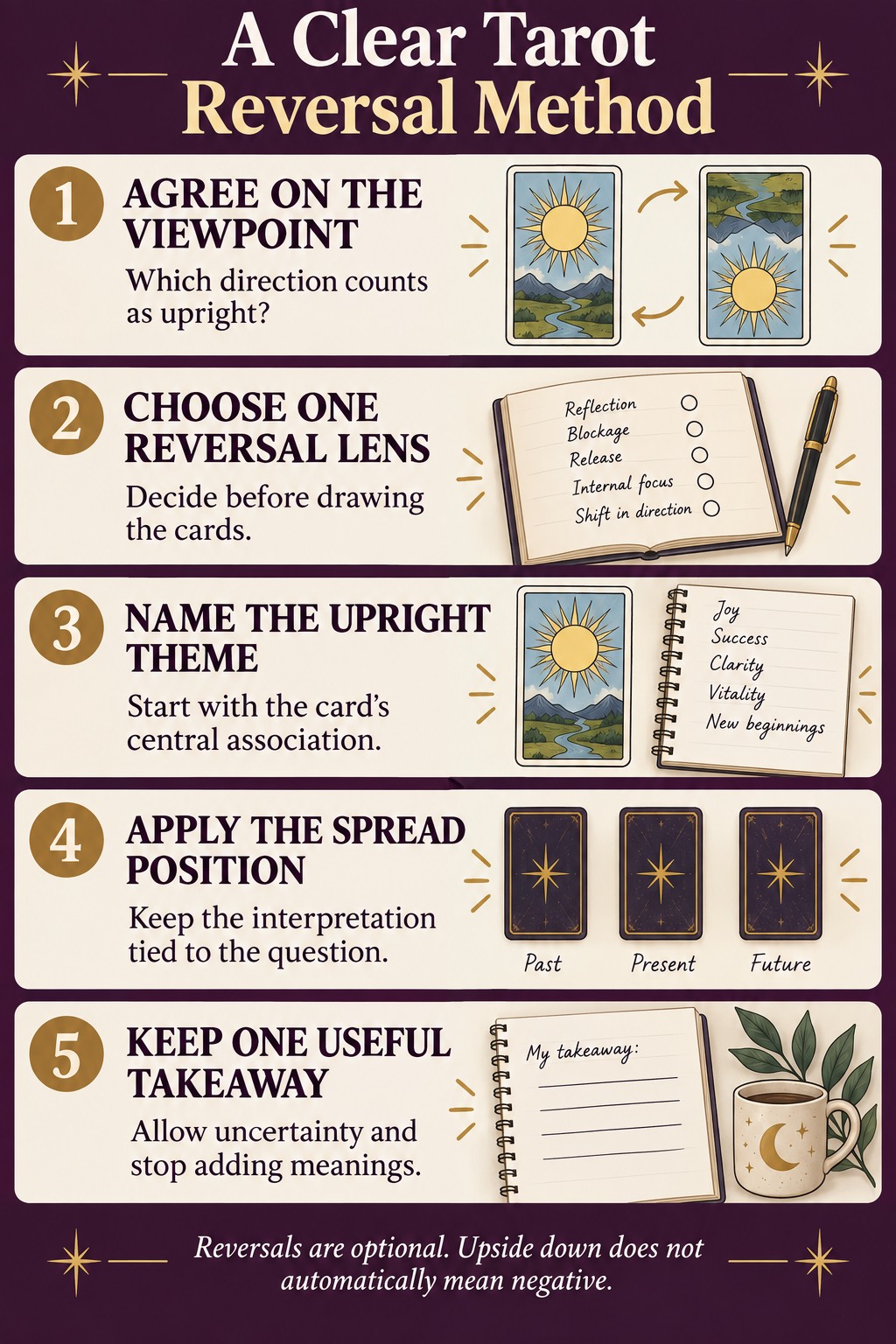
Read the infographic as text
- 1. AGREE ON THE VIEWPOINT: Which direction counts as upright?
- 2. CHOOSE ONE REVERSAL LENS: Decide before drawing the cards.
- 3. NAME THE UPRIGHT THEME: Start with the card’s central association.
- 4. APPLY THE SPREAD POSITION: Keep the interpretation tied to the question.
- 5. KEEP ONE USEFUL TAKEAWAY: Allow uncertainty and stop adding meanings.
Begin with the Upright Theme
Give the card a short upright association before applying a reversal rule. For the Three of Pentacles, you might begin with cooperation or shared skills. In a position about learning, that association concerns how you work with others; it does not identify an unknown event.
Keep the image and your deck’s guidebook beside the note. The reversal should modify that starting point, not replace every card with the same vague warning.
Choose One Reversal Lens
Different methods explore difficulty expressing a theme, inward focus, imbalance or a guidebook’s defined meaning. Choose one before drawing. If you use difficulty expressing a theme, a reversed Three of Pentacles might become the question, “What would make collaboration easier?”
Under an inward-focus method, the same card could prompt, “Which skill am I developing privately before sharing it?” These are alternative practice methods. Do not combine them after the draw simply to fit whichever answer feels most appealing.
Reversals Don’t Always Mean Opposite
Turning an image upside down doesn’t mean that you turn every meaning into the exact opposite. If an upright card suggests clarity, the reversal needs to mean something, but not always deliberate deception. It might get you to ask questions about incomplete information, private understandings, or having a hard time explaining something.
Also, a difficult upright theme doesn’t become a guaranteed positive outcome when it’s reversed. A card that’s connected with conflict can’t promise that everything will work out just because it faces the other way.
The opposite approach can be used as a deliberate reading convention but has its limits. Real situations don’t usually fit neatly into success or failure, honesty or dishonesty, and love or rejection.
Try to replace the verdict with a question. Instead of asking, “Does this mean the project will fail?” ask, “Which part of the project do I need to pay attention to before I continue?” This leaves room for information, action, and change.
Spread Positions
A card’s position can tell you what part of the question is being asked. The same reversal might tell you that different reflections in different positions have different approaches, support, and things to consider.
A reversed Four of Swords in the current approach position, for example, could prompt you to talk about having a hard time taking a break. In a support position, it might tell you to look at questions that would make rest possible. Neither of these interpretations means a health condition.
Pick the spread positions before you draw. Relabeling a position after can make it more confusing. This also hides how the reader has changed the method.
Bunning's introduction to tarot spreads explains the role of positions in shaping a reading. You can use that structural idea while keeping your own conclusions provisional and grounded in the question being asked.
A Practical Example of Learning Something New
Imagine Maya is learning photography and asks, “What could help me enjoy practicing photography more?” She decides to use two cards. The first represents what she’s doing now, and the second represents something she could try differently. She draws the Eight of Pentacles reversed followed by the Page of Wands upright.
Maya has decided to look at reversed cards for possible imbalances, so the Eight of Pentacles reversed makes her think about how she’s been practicing. She realizes that she’s become so focused on taking the perfect picture that photography isn’t as enjoyable as it used to be. She also spends a lot of time comparing her pictures with those taken by experienced photographers instead of giving herself room to experiment and learn.
The Page of Wands makes her think about curiosity and trying something new. Maya decides to give herself a simple challenge. She’ll take pictures of one ordinary object from several different angles without worrying about making the pictures perfect or posting them for anyone else to see. This gives her a chance to experiment without putting so much pressure on herself.
Someone else could look at the same two cards and come up with a completely different interpretation. Maya’s reading is useful because it helped her recognize something she could try, not because the cards proved exactly why she was struggling. After trying the exercise, she can decide if it actually helped her enjoy photography more. If it didn’t, she could try something different.
A Second Example with an Overloaded Schedule
Imagine someone who volunteers regularly and has gradually taken on so many responsibilities that the role is becoming overwhelming. While thinking about the situation, they draw the Ten of Wands reversed. Before beginning the reading, they decided to look at reversed cards in terms of what they might need to release or let go of.
The card might encourage them to think about everything they’ve taken on and ask if some of those responsibilities could be shared with other people. That doesn’t mean they should immediately quit or start dropping responsibilities without talking to anyone. They still need to look at what they actually agreed to do, what deadlines are coming up, and which tasks someone else could realistically handle.
After thinking it through, they might decide that a good first step is talking with the volunteer coordinator about giving one of their regular tasks to someone else. That’s a small and realistic change that could make the workload easier to manage without leaving everyone else scrambling.
The Ten of Wands reversed didn’t prove that the other volunteers were taking advantage of them or tell them exactly what they had to do. Instead, the card helped bring their attention to a question they could actually do something about. Sometimes that’s enough for a tarot reading to be useful. The cards don’t have to make the entire decision for you to walk away with something worth thinking about.
Practice With One Card at a Time
A simple way to practice reversed cards is to start with just one card instead of doing an entire reading. Pick a card on purpose and write down what its main upright meaning means to you in your own words. Then pick one way of looking at the reversed meaning and turn it into a simple question you can think about.
For example, the upright Three of Pentacles can represent cooperation and people bringing different skills together. If you’re looking at the reversed card as something happening more internally, you might ask, “What am I learning or developing that I haven’t shared with other people yet?” If you’re using the reversal to look for an imbalance, you might ask, “Are we dividing the work in a way that actually works for everyone?”
You don’t have to combine those interpretations or decide that one of them is always the correct meaning of the reversed Three of Pentacles. They’re two different ways of working with the same card. Practicing this way can help you see how changing the way you approach a reversal can also change the questions you ask.
Keep your notes fairly short so you can easily go back and look at them later. After you’ve practiced with several cards, pay attention to any meanings that start sounding too similar. If every reversed card eventually turns into “something is blocked,” for example, try making your questions more specific. You might also find that a certain way of reading reversals just doesn’t work very well for you, and that’s okay.
You can also practice with the same card while thinking about different parts of everyday life. The Three of Pentacles might bring up one question when you’re thinking about learning how to cook and something completely different when you’re thinking about organizing a workspace with someone else. Write down what came from the traditional meaning of the card and what came from your own situation. This can help you notice how much your own experiences and circumstances naturally become part of the way you read a card.
What If Most of Your Cards Are Reversed?
Seeing a spread with a lot of reversed cards can look a little dramatic, especially if you’re new to reading reversals. It doesn’t automatically mean that something bad is about to happen, that you have bad luck, or that there’s something wrong with you spiritually. Sometimes the way the deck was shuffled or handled simply results in more cards facing one direction.
Before giving the reversals a deeper meaning, take a quick look at your deck. Maybe a large section accidentally got turned around while you were shuffling, or maybe you’ve been leaving the cards in the same positions after each reading. You can check those simple possibilities first and still keep whatever personal or spiritual meaning tarot has for you.
After that, read each reversed card based on its position in the spread and the approach you’ve decided to use. Try not to add an extra negative meaning just because several cards happened to come out reversed. Each card can still be considered individually and in relation to the question you’re exploring.
If the reading starts feeling overwhelming or you end up with so many possible meanings that you’re more confused than when you started, it’s okay to stop. Pick one useful question or idea from the reading and leave the rest for another time. You can also go back to reading only upright cards while you’re learning. Using a simpler method doesn’t mean you’re doing tarot wrong. Sometimes keeping things simple is exactly what makes it easier to learn.
Keep Hard Images Limited
Cards such as Death, the Devil, or the Tower card can have strong imagery, upright or reversed. Just because they show up doesn’t mean they diagnose an illness, establish that you have a curse, or prove abuse. A reader shouldn’t use them to scare you into buying another service.
If the card reminds you of a real concern, talk about that concern with relevant support and evidence. A problem with a contract should be carefully reviewed in the contract. A health concern needs to be discussed with a healthcare professional.
You can also decline an interpretation that feels intrusive or too certain. A spiritual reading should allow for questions, disagreements, and clear endings. You don’t owe a reader private information to help an alarming claim make sense.
For your own practice, don’t repeatedly draw cards. Put the deck away, then process the information and let it help you think. Grounding activities and conversation with someone you trust might be more useful at this point.
Final Thoughts: Let Clarity Build Confidence
Confidence with reversal grows stronger when you explain your process, such as the card’s central theme and the approach you selected for the spread positions. This is different from claiming that every interpretation shows a hidden fact.
Allow yourself to say that you’re not sure. Some images might not connect with the question, and some readings will feel meaningful but not give a practical next step. Neither does this situation need a forced answer.
If you use reversals here and there, regularly or not at all, keep your practice consistent. Make sure that your practice supports reflection and choice. An upside-down card can add information to the reading, but it doesn’t have to take away your sense of perspective or the authority you have over your own life.
For connecting several cards, see our tarot card combinations method.
For the next step, explore reading symbols thoughtfully.
Frequently asked questions
1. What makes a tarot card reversed?
Its image is upside down in the reading direction you agreed to use. Decide whose viewpoint matters when reader and participant sit across a table.
2. Do I have to use reversals?
No. Upright cards and spread positions can still explore challenges. Choose your convention before drawing rather than selectively using it afterward.
3. Should beginners learn upright meanings first?
That can be a useful way to reduce the amount being learned at once. You can add reversals later or remain with upright readings.
4. Does reversed always mean opposite?
No. Different methods consider inward focus, difficulty expressing a quality, imbalance or guidebook meanings. An opposite is only one possible convention.
5. Are all reversed cards negative?
No. Orientation is an interpretive choice, not evidence of misfortune. Read the theme in the position rather than adding an automatic negative label.
6. Should I use every reversal meaning I know?
No. Choose one clear method for the reading. Piling on conflicting meanings makes it harder to explain how you reached a conclusion.
7. Why begin with the upright theme?
It supplies the quality your reversal lens modifies. Keeping that theme visible prevents every reversal from becoming the same vague idea of a block.
8. How does the position change a reversal?
It defines the card’s role. A theme in a support position invites a different question from the same theme in a position about your current approach.
9. What if a card turns accidentally while I lay it down?
Follow the orientation rule you chose beforehand and note the handling issue. Do not invent a compulsory spiritual meaning for an accidental rotation.
10. How can cards become reversed during shuffling?
Parts of the deck can be rotated or laid down in different directions. Physical handling can explain orientation without requiring a hidden message.
11. Do many reversals mean bad luck?
No. Check deck handling and interpret the cards within your method. The count does not establish bad luck or a curse.
12. Must my guidebook include reversed meanings?
No. Some guides do and others do not. You can use the deck upright or follow a clearly stated method that suits your learning.
13. What is a useful one-card exercise?
Choose a card deliberately, record its upright theme and apply one reversal lens to a low-stakes question. Write a short prompt rather than a prediction.
14. Can I change my reversal method?
Yes between practice sessions. Record the change and keep the rules consistent within a reading so your notes remain understandable.
15. When should I stop interpreting?
Pause when more meanings create confusion or repeat the same concern. One useful question and an acknowledged uncertainty can be a complete ending.