

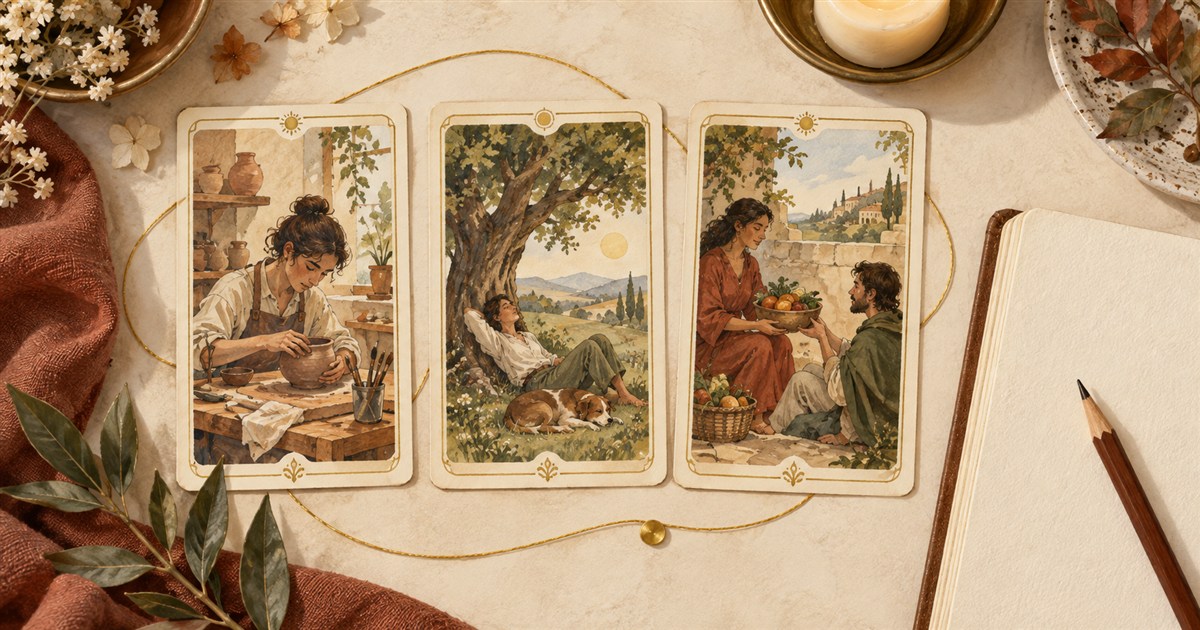
Tarot card combinations become easier when each card has a clear theme and a defined role. Connect those themes with words such as and, but, through or while, then check whether the sentence answers your original question.
Start with two or three cards and keep the interpretation traceable. A coherent symbolic story can support reflection, but it does not establish causes, hidden motives or guaranteed outcomes.
Four ways to connect card themes
| Connecting word | Relationship between themes | Reflective example |
|---|---|---|
| And | Coexistence | Practice and rest both need room |
| But | Tension | Enthusiasm but limited time needs a smaller plan |
| Through | An approach | Learning through cooperation suggests seeking feedback |
| While | Two needs together | Progress while protecting rest suggests a stopping point |
Scroll sideways to see the full table.
Keywords and Combinations
If you associate the Ace of Cups with a new creative impulse, for example, and the Four of Pentacles with keeping resources, putting those ideas together could lead you to ask a question about how to look at new ideas with a limited budget.
This doesn’t mean that the pair always predicts a business opportunity or a financial restriction. The same card in a reading about a hobby might encourage reflection on the supplies you already have instead of buying something new.
Context makes the difference. The question, positions, images, and information you have can shape the connections that are useful. Without them, a combination can be broad enough to fit in almost anything.
tarot educator Joan Bunning's lesson on card pairs explores how comparing cards can highlight relationships between their themes. That is an interpretive approach within tarot practice, not evidence that a pair establishes facts about events or other people.
Start with a Workable Question
Pick a question that’s narrow enough for a small spread. You might ask, “What could help me organize my next project?” This allows the cards to have a clear task instead of asking what’s going to happen in my life. The first question also leaves room for you to make your own decisions.
Don’t combine different unrelated concerns in one question. If you ask about work or a relationship, keep the questions the same. Almost any card can seem relevant somewhere else, but it becomes harder to tell if the interpretation is helping when you add more questions.
For practice, pick low-stakes situations that you already understand. You can then compare the interpretations with the information you have instead of relying on the cards to give you missing facts.
Write the question before you shuffle, and if it changes during the reading, pay attention to the change. A new question might need a separate conversation or another reading later instead of a silent change that makes the existing cards look more specific.
Connect Tarot Cards in Five Steps: visual guide
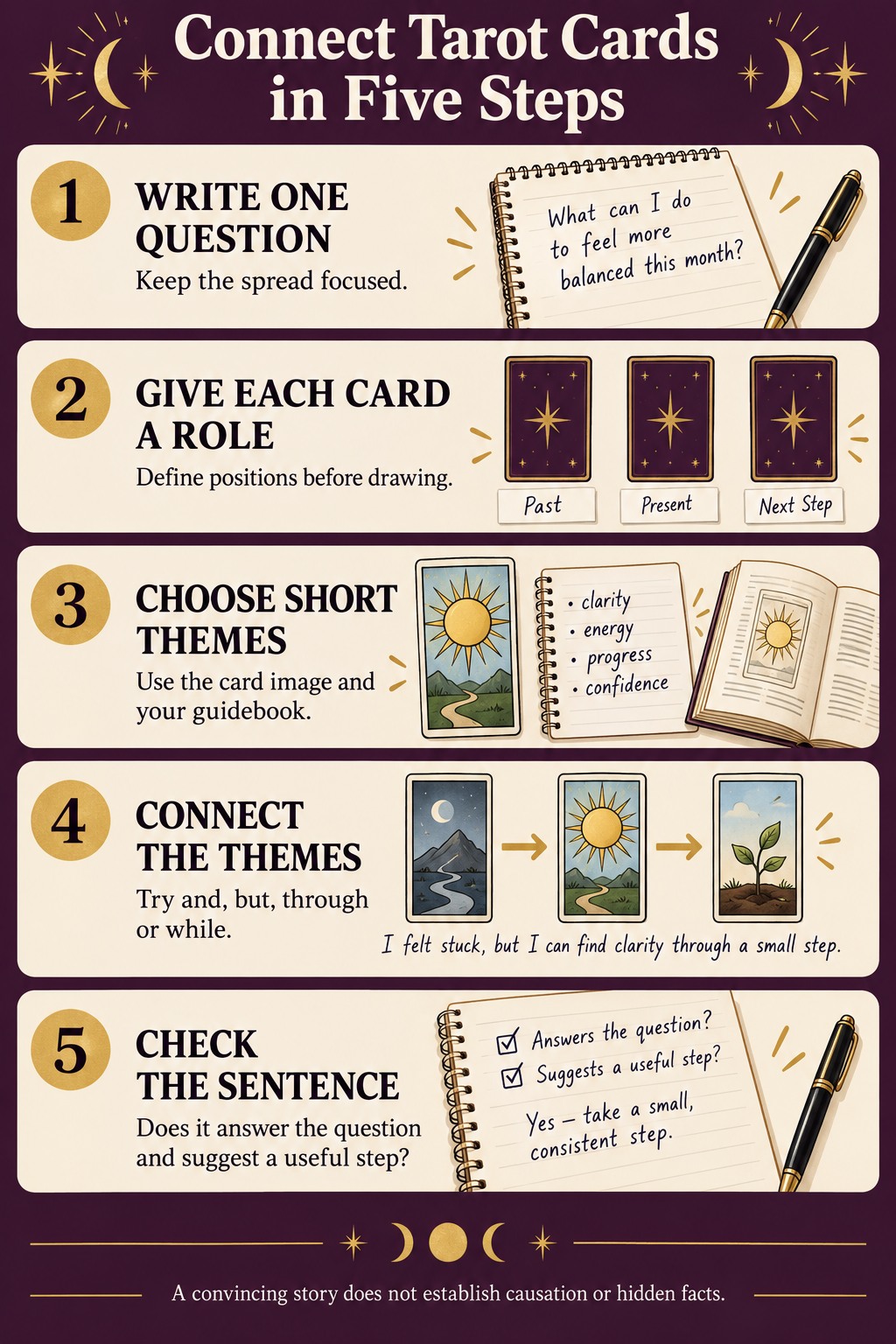
Read the infographic as text
- 1. WRITE ONE QUESTION: Keep the spread focused.
- 2. GIVE EACH CARD A ROLE: Define positions before drawing.
- 3. CHOOSE SHORT THEMES: Use the card image and your guidebook.
- 4. CONNECT THE THEMES: Try and, but, through or while.
- 5. CHECK THE SENTENCE: Does it answer the question and suggest a useful step?
Give the Cards a Role
A three-card spread can be your current approach, source of friction, and useful adjustment. These positions ask how you’re engaging with the situation, what needs attention, and what you can consider trying new.
Other structures can also work. You might use sentences like “What I understand, what I need to ask, and what I can do next.” Pick the roles before you ask the question.
According to Bunning's introduction to spreads, positions shape a card’s interpretation. For combinations, positions also tell you how the cards should relate. A card in a support position is doing a different job from the same card in an obstacle position.
Keep the rules written down on paper when practicing. This helps to reduce the temptation to give every card a meaning, no matter what was drawn, to be explored.
Start With Each Card’s Main Meaning
Before connecting the cards, give each a short central theme. The Eight of Pentacles might suggest practice, the Four of Swords rest, and the Six of Pentacles giving and receiving. Use your deck’s guidebook and the picture rather than collecting every possible keyword.
Then relate each theme to the role you assigned in the spread. Practice in a position about your current approach is different from practice in a position about a useful adjustment. The question and position help you decide which association deserves attention.
Keep the individual themes visible in your notes. That makes it easier to explain how you moved from separate cards to a combined interpretation. If a card does not fit the question, leave it unresolved instead of inventing a hidden event.
Four Ways to Connect Two Cards
Use “and” to notice two themes together. Practice and rest might invite you to think about a learning routine that includes breaks. Neither theme has to cancel the other.
Use “but” to explore a tension. Enthusiasm but limited resources might become a question about the size of a project you can realistically begin. This is an interpretation to check against the situation, not proof of an unseen restriction.
Use “through” to explore an approach. Learning through cooperation might suggest asking someone for feedback or finding a group where you can practise. Decide whether that action fits your actual circumstances.
Use “while” to hold two needs at once. Making progress while protecting time for rest can help you avoid turning a spread into an either-or instruction.
Be cautious with “because.” Two symbolic themes appearing together do not establish causation. Cards associated with uncertainty and distance do not prove that someone is withdrawing because they are hiding something. A factual explanation needs information beyond the cards.
Choose the connection that best fits the original question, or record more than one possibility. You do not need a universal dictionary in which every pair has one fixed meaning.
An Example of Starting a Community Project
Imagine Noor wants to start a monthly craft group in her neighborhood. Instead of asking if the group will be successful, she asks, “What could help me make the first meeting manageable?” She uses a simple three-card spread for what she’s doing now, what might be making things harder, and something she could adjust.
Noor draws the Three of Pentacles, Seven of Cups, and Temperance. She keeps the meanings simple. The Three of Pentacles makes her think about working together, the Seven of Cups represents having a lot of possibilities, and Temperance brings up balance. With the Three of Pentacles in the first position, Noor realizes that she doesn’t have to plan and handle everything by herself. Other people in the neighborhood might have ideas, skills, or practical ways they can help.
The Seven of Cups appears in the position representing what might be making things harder. When Noor thinks about it, she realizes just how much she’s trying to include in the very first meeting. She’s considered having a workshop, an exhibition, refreshments, a craft swap table, and even a guest speaker. Those ideas might all be fun eventually, but trying to do everything at once could make getting started much harder than it needs to be.
Temperance encourages her to think about creating something more balanced and manageable. When she puts the three cards together, her reading becomes something like, “Working with other people could make this easier, but I need to narrow down my ideas and start with something simple.”
Noor decides to ask one neighbor to help her host a relaxed two-hour craft session for the first meeting. If that goes well, she can always add more activities later. The cards haven’t promised that a certain number of people will show up or that the group will become a success. They’ve simply helped Noor recognize one realistic change she can try and see how it works.
An Example of Cards That Seem to Disagree
Sometimes two cards can seem like they’re telling you completely different things. Imagine drawing the Knight of Wands with the Four of Swords while thinking about a personal writing project. The Knight of Wands might make you think about excitement, energy, and wanting to move forward, while the Four of Swords can bring up rest, slowing down, and taking a break. At first, the cards might seem like complete opposites.
Instead of deciding that one card has to cancel out the other, think about how both ideas could be true at the same time. Maybe you’re genuinely excited about your writing project and have plenty of ideas, but you’re also trying to accomplish too much every time you sit down to work. The two cards might lead you to ask, “How can I use this excitement without expecting myself to be productive all the time?”
The positions of the cards can help too. If the Knight of Wands represents what you’re doing now and the Four of Swords represents something you could adjust, you might decide to try shorter writing periods with a planned stopping point. That gives you a chance to use your creative energy without feeling like you have to keep going until you’re completely worn out. If those cards appeared in opposite positions, you might look at the situation differently.
The cards aren’t diagnosing exhaustion or telling you what you medically need to do. They’re simply giving you another way to think about your pace and how you’re approaching the project. Your actual schedule, energy, responsibilities, and experience still matter. Tarot can help you notice something worth thinking about without having to explain the entire situation for you.
Adding a Third Card
When you go from two to three cards, don’t build a separate story for each pair. Start with the roles already defined in the spread. Ask what the third card adds to the question.
The Ace of Pentacles and the Page of Pentacles, for example, might suggest practical beginnings of learning a new project. If the third card is a Two of Wands, it should prompt a comparison of realistic routines before committing.
A combined reflection might say something like, “There’s an opportunity to learn something new, and it would help to compare the paths available before I pick a course.” This is a clear way to ask a question and add the third card.
You can look at the information that’s missing, such as cost, scheduling, prerequisites, or the quality of the instruction. The next step is to get the information instead of drawing more cards to fill the gaps.
Repeated Themes
Cards from the same suit can invite you to look at recurring areas in your life. In many tarot traditions, common suit associations include:
- Pentacles: resources
- Cups: emotions
- Swords: thought and conflict
- Wands: creative drive
These associations are just suggestions and can be different by deck. They should help you ask questions instead of restricting each interpretation. A Cups-heavy reading about work might talk about motivation or team relationships, not romance. Repeated numbers, gestures, or figures that face toward or away from each other can catch your attention. Notice the pattern before deciding what it means. The observation in the figures that face away can mean that it needs attention in different directions.
Using Reversals
If you use reversals, define the method before drawing: for example, inward focus, difficulty expressing a theme, imbalance or your guidebook’s convention. If you read upright only, use that rule consistently.
A reversal doesn’t automatically cancel the card beside it. A reversed card next to a practical card might invite questions about what conditions would support expression. It doesn’t prove that creativity is impossible or that practical responsibilities are the cause.
For learning, keep the reversal interpretation short. Connect the themes in the same way that you would the cards if they were upright, and don’t add more meanings at every stage because this can be confusing.
If the reversal makes the exercise too hard, practice the combinations upright first. You can work on one skill at a time without making your reading less important or less spiritually meaningful.
Let Your Questions Be Accountable
A good story can feel persuasive just because the parts fit together. This is a reason to pause and look at the interpretation, even if it feels intuitive.
Bunning's lesson on creating a tarot story describes bringing individual elements into a connected reading. In your own practice, add an explicit reality check: which details came from known information and which did you infer from the cards?
Ask if the story still needs to be addressed with the original question. If a reading about organizing a project has a claim about someone else’s private motives, go back to what you agreed on.
A useful ending can be one where insight and unanswered questions work together. You don’t have to supply a complete account of anyone’s thoughts or future each time you get a reading to feel worthwhile.
Build a Journal
Write down the question, position, cards, and themes. Add a note about what you knew when you started and then write down whether the interpretation led to useful questions or actions.
If the same pair shows up again, compare the context before doing an old interpretation. A combination that works with demanding work schedules is one reading and might ask different questions than family responsibilities.
Don’t keep only striking matches. If you have an unclear reading and interpretations get revised, this makes your journal a record of learning instead of a collection that shows up to prove every reading is accurate.
Knowing When to Stop Adding Cards
Clarifying cards can become a way to postpone uncertainty. Before you add new cards, say what is unclear and whether the card has a way to explore it. Sometimes the missing information comes from conversations, documents, or getting professional help.
If you’re a beginner, stay with two original cards. If there are no clear interpretations, write that down at the end of the reading. A partial reading is more important than a story that comes from guesses.
Tarot card combinations are best when they help you think with more detail and flexibility. Give each of the cards a role and connect the themes carefully. Always leave room for more interpretations. The reading aims to help you understand and reflect on your decisions in a grounded way.
If your practice includes upside-down cards, see how to read tarot reversals.
For the next step, explore tarot and self-reflection.
Frequently asked questions
1. Does every tarot pair have one fixed meaning?
No. The question, positions, deck and known situation shape the interpretation. A pair dictionary can offer ideas without deciding every reading.
2. How many cards should I start with?
Two cards can be enough for practising a connection. Add a third only when it has a defined role that helps the question.
3. What should I do before drawing?
Write one focused question and the position names. This gives the cards a relationship to explore instead of an unlimited story.
4. How long should each card’s theme be?
Keep it short enough to remember, such as practice, rest or cooperation. You can expand it later if the image and context support that detail.
5. What does and do in a combination?
It lets two themes coexist. Practice and rest can both belong in a learning routine; one need not cancel the other.
6. What does but do?
It highlights a tension to examine, such as enthusiasm but limited time. Check whether the tension is present in the actual situation.
7. What does through do?
It suggests an approach within the interpretation. Learning through cooperation might prompt you to ask for feedback, if that fits your circumstances.
8. What does while do?
It holds two needs together, such as making progress while protecting rest. This can prevent an unnecessary either-or conclusion.
9. Why be careful with because?
It can turn neighbouring symbolic themes into a causal claim. Cards appearing together do not prove why an event happened or what caused someone’s behaviour.
10. What if the cards seem to disagree?
Consider whether both themes can be relevant or whether positions assign them different jobs. You can also record the uncertainty instead of forcing a resolution.
11. How should a third card join the reading?
Ask what its assigned position contributes to the existing question. Avoid inventing a separate story for every possible pair.
12. Do repeated suits prove the subject of a reading?
No. They can prompt attention to a traditional theme, but context matters. A Cups-heavy work reading need not become a romance reading.
13. How do reversals affect combinations?
Apply the chosen reversal rule to the individual card first, then connect the resulting themes. A reversal does not automatically cancel its neighbour.
14. What belongs in a combinations journal?
Record the question, positions, cards, short themes, connecting sentence and what you already knew. Include unclear readings as well as useful ones.
15. When should I add a clarifying card?
First identify what is unclear and whether another symbolic prompt can help. Missing factual information may require a conversation or document instead of another card.