

The most useful questions to ask tarot are specific enough to give the reading direction and open enough to invite reflection. Start with one situation, focus on your own choices and ask what you can understand or do next. “How can I prepare for this opportunity?” usually gives you more to work with than “Will everything work out?”
You can approach tarot as a spiritual practice, an intuitive conversation or both. A clear question helps you connect the cards to the subject you brought, without asking them to decide your life for you.
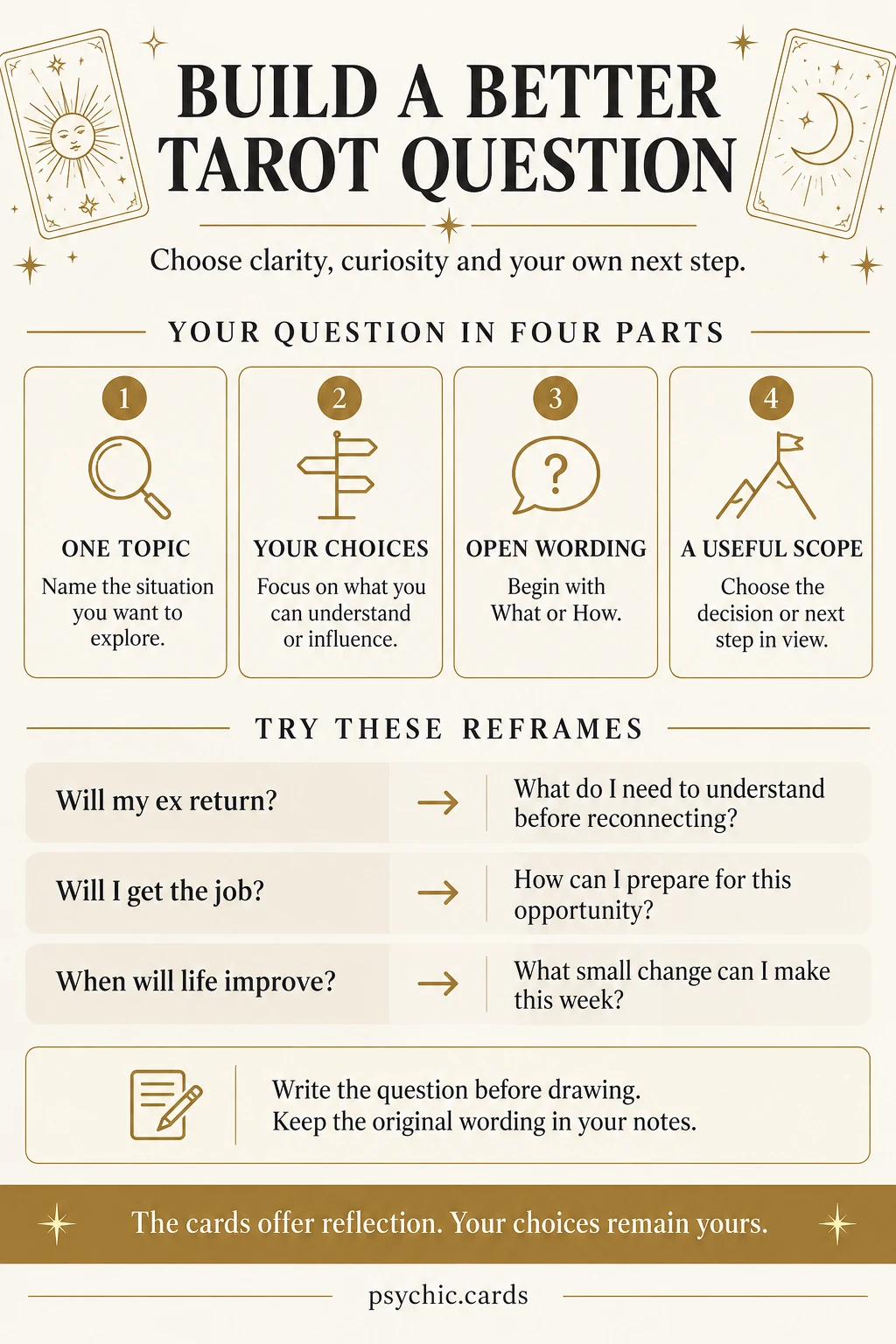
Build your question in four parts
1. One topic
Name the situation: a job application, a conversation or a habit. Avoid putting your entire future into one question.
2. Your choices
Focus on what you can understand or influence, including boundaries, preparation and how you respond.
3. Open wording
Begin with “What” or “How” when you want room for a fuller discussion. A question should invite possibilities.
4. A useful scope
Choose the decision or next step in view. A time frame can organise reflection without becoming a predicted deadline.
Turn a vague question into a workable one
| Starting question | A more useful version | What changes |
|---|---|---|
| Will my ex return? | What do I need to understand before reconnecting? | Your readiness and boundaries come into view. |
| Will I get the job? | How can I prepare for this opportunity? | You have something to act on. |
| When will life improve? | What small change can I make this week? | The topic becomes manageable. |
| What is wrong with me? | What support or perspective would help me now? | You replace blame with a compassionate question. |
Questions for love and relationships
Bring your feelings into the reading without asking the cards to override another person’s consent or tell you every private thought they have. Think about communication, mutual effort and the behaviour you can actually observe.
- What relationship pattern am I ready to understand more clearly?
- How can I express my needs with kindness and honesty?
- What boundary would help me feel more secure?
- What should I consider before reconnecting with someone?
- How can I make room for a mutual, respectful connection?
If a card suggests distance or conflict, discuss the symbolism rather than treating it as proof of betrayal. Use actual conversations and behaviour to assess the relationship. Our guide to reading tarot reversals can help you avoid turning an upside-down card into an automatic bad omen.
Questions for career and practical direction
Ask about preparation and priorities. Keep decisions about offers, contracts and spending connected to the facts you can verify.
- What strength could I bring to my next work challenge?
- How can I prepare for an interview or important conversation?
- What assumption about this opportunity should I examine?
- What trade-off should I think about before choosing?
- What small step would help me explore a different direction?
You might use a reading to identify a skill to practise, then check job requirements and speak with the appropriate people. A hopeful card is encouragement to reflect, rather than confirmation that an application or investment will succeed.
Questions for personal growth
- What habit deserves more of my attention?
- Where am I overlooking a source of support?
- How can I respond more patiently to uncertainty?
- What value do I want to express through my next decision?
- What am I ready to release, and what would that look like in practice?
Keep questions gentle enough to consider honestly. If “What am I blocking?” makes you feel blamed, try “What could make the next step easier?” The reading should give you room to explore rather than label every difficulty as your fault.
Questions for decisions and change
- What matters most to me in this decision?
- What practical information do I still need?
- How might I approach option A thoughtfully?
- How might I approach option B thoughtfully?
- What is one reversible step I can take before committing?
Give each option the same kind of question. Comparing “Will option A ruin my life?” with “What wonderful things will option B bring?” builds your preferred answer into the spread before any card appears.
A three-card spread for a clear question
1. What to understand
A theme or perspective to examine in this situation.
2. What to consider
A resource, challenge or assumption worth discussing.
3. My next step
A possible response you can evaluate and choose freely.
Write the positions before drawing. Describe each card’s imagery, connect it with the position and then look at how the cards relate. Our practical method for tarot card combinations explains how to build an interpretation without treating three separate keywords as a complete answer.
Leave some questions with the appropriate person
Tarot should not diagnose illness, establish a legal right or settle someone’s private feelings as fact. Use health professionals, legal advice and direct communication where needed. You can still explore how to prepare for a difficult conversation or what support would help you.
Some readers use yes-or-no or timing methods. Ask how they work and what uncertainty remains. If you need a date, rely on the appointment, deadline or information from the people involved. “What needs attention before I move forward?” can be more useful than a promised month.
Prepare for your reading
Choose a quiet place, write one main question and tell the reader which subjects you want left out. A brief breath, prayer or grounding ritual can help you settle if it fits your practice; you do not need to feel perfectly calm to ask a worthwhile question.
Ask whether you may take notes and how clarification works. Reader preferences about shuffling and handling the deck vary. For more on format, see questions to ask before an angel or tarot reading.
Use the reading before repeating the question
Keep the original question, cards and interpretation together in your notes. Choose one idea to reflect on or a manageable action to try. Return to the topic when something relevant changes or a different question emerges; there is no required monthly schedule.
Repeatedly drawing until you like the answer can make it harder to hear your own judgment. If the urge is driven by fear, put the deck aside and speak with someone you trust. You can leave a question open for a while.
Frequently Asked Questions
1. What makes a useful tarot question?
One clear topic, attention to your own choices, open wording and a manageable scope.
2. Must every question start with What or How?
No, but these openings often invite a fuller conversation. Choose wording that fits the kind of reflection you want.
3. Are yes-or-no questions forbidden?
No. Some readers use them. Ask about the method and its uncertainty, and consider what information an open question could add.
4. How specific should I be?
Name the situation and next step without trying to force a preferred answer. Avoid combining several unrelated concerns.
5. Can I ask about my ex?
You can explore your feelings, readiness and boundaries. Do not treat cards as proof of the other person’s private thoughts or consent.
6. What is a useful career question?
Ask what you can prepare, what strength you can use or what assumption you should examine, then check the practical facts.
7. Can tarot give an exact date?
Timing methods are interpretive. Use actual appointments, deadlines and information from the people involved when you need a date.
8. Can I compare two options?
Yes. Ask the same type of question for each option and examine practical trade-offs alongside the reading.
9. Can tarot diagnose a problem?
Do not use tarot for medical diagnoses or legal determinations. Consult the appropriately qualified person.
10. What if my question sounds self-critical?
Try compassionate wording, such as asking what support or perspective would help rather than what is wrong with you.
11. Should I write the question before drawing?
Yes. It keeps the original purpose clear and helps you review the interpretation without changing the question afterward.
12. How many questions should I bring?
Start with one main question and a few possible clarifications. Check the reader’s format, time and question allowance.
13. Do I have to shuffle the cards?
Reader preferences vary. Ask how the deck will be handled and choose an arrangement that feels comfortable.
14. When can I ask the same question again?
There is no compulsory interval. Return when something relevant changes or a different question emerges, rather than drawing until you like the answer.
15. What should I do after the reading?
Keep the question, cards and interpretation together. Choose one idea to reflect on or a manageable action you can evaluate.