Swords · Air · Minor Arcana
The King of Swords is an image of judgment, expertise and responsibility for decisions. It asks whether authority is being exercised with clear reasons and fair standards. It does not require obedience to a particular person or identify a man who will control your future.
Upright
Reasoned judgment, expertise, standards and accountable authority.
Reversed
Rigid thinking, misuse of authority, selective reasoning or unfair judgment.
A question to explore
What standard supports this decision, and can it be explained fairly?
Imagery and symbolism
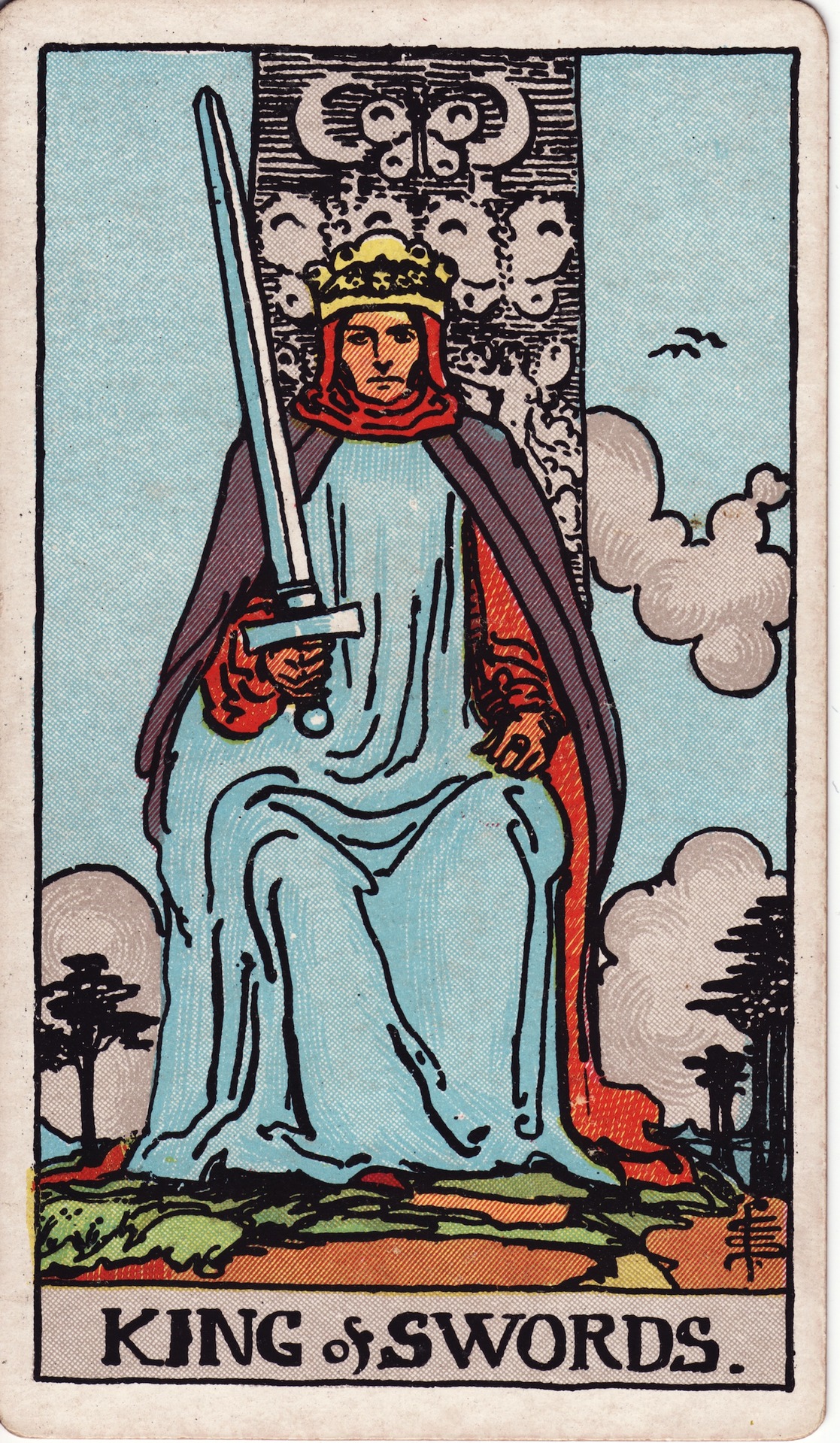
The Rider–Waite–Smith King faces forward on a throne while holding a sword. The composed posture contrasts with the Knight’s charge. Modern interpretations often use this difference to distinguish sustained judgment from immediate action; the image cannot establish anyone’s actual competence.
King of Swords upright
Upright, make the reasoning visible. Define the decision, identify relevant evidence and apply a consistent standard. Expertise is most useful when it can acknowledge uncertainty and explain its limits, not merely demand trust.
King of Swords reversed
Reversed, examine whether a rule is being applied selectively or confidence is replacing evidence. You may need another perspective or an appropriate review process. The card does not authorize harshness, punishment or unquestioning submission.
Love and relationships
Reasoned discussion should leave room for feelings and consent. Do not confuse control with stability. A partner’s gender or status does not give them the right to make every decision.
Work and study
Clarify decision-making authority, responsibilities and the evidence a task requires. Seek advice from someone with relevant qualifications, while keeping responsibility for your own choices.
Money and practical decisions
Read agreements carefully and use appropriately qualified advice for legal or financial matters. Tarot cannot establish which professional is trustworthy or what a dispute’s outcome will be.
Past, present and future positions
Past
Reflect on a rule or authority figure that shaped your approach to decisions, without assuming the influence was necessarily beneficial.
Present
Make the evidence and criteria for a decision explicit.
Future
Consider how a decision could be reviewed if new information emerges.
Well-being and personal growth
Use the card’s theme to organize questions for a practitioner, not to diagnose or replace their assessment. Authority should not prevent you from asking for clarification.
How it differs from nearby cards
The Knight of Swords emphasizes urgent action; the King emphasizes judgment that remains accountable over time. The Queen brings a closely related focus on discernment and boundaries.
Try this reflection exercise
- State the decision and who is affected.
- List the relevant evidence and uncertainties.
- Check whether the same standard would apply to everyone involved.
Frequently asked questions
Is the King of Swords a yes or no card?
Readers assign different yes-or-no conventions. A more useful approach is to explore the card’s theme and then check the real conditions of your decision. What standard supports this decision, and can it be explained fairly?
Must I follow the advice of the person this card represents?
No. Consider qualifications, evidence, your circumstances and your own boundaries. A card does not confer authority or remove your right to question advice.
Do reversed cards always have a negative meaning?
No. A reversal may be read as a delay, an internal experience or a theme that needs adjustment. Decide how you use reversals before the reading and consider the question and surrounding cards.
Historical reference: A. E. Waite, The Pictorial Key to the Tarot. The practical questions here are contemporary interpretations of the imagery, not factual predictions.
The analysis of the King of Swords card brings to light the nuanced role of authoritative figures in one’s life. The interpretation spans various aspects, offering a holistic view.
The present and future implications of the King of Swords card suggest a significant focus on personal growth and leadership. The advice on finding mentorship in the workplace is quite practical.
The inclusion of the reverse meaning of the King of Swords card is particularly insightful. It adds depth to the interpretation and prepares readers for potential negative aspects.
It is interesting to see how the King of Swords card’s symbolism is tied to air as an element. It aligns well with the themes of authority and intellectual rigor.
I appreciate the detailed breakdown of how the King of Swords card can influence different areas such as work, love, and finances. It provides a comprehensive guide for readers.